


About Wahsega
About Wahsega
Welcome!
What We Do
Georgia 4-H Summer Camp
Georgia 4-H Environmental Education Program
As one of the nation’s largest providers of residential environmental education, the Georgia 4-H Environmental Education Program invites you and your students to join the safe haven of Georgia’s outdoor classroom. The Wahsega 4-H Center EE program uses the outdoors as a classroom without walls to provide overnight academic field studies for students in public, private, and home-based learning in grades K-12.
Operating September through November and March through May of each year, Wahsega 4-H Center provides opportunities for high-quality day and overnight educational experiences. Our research-based curriculum correlates to current Georgia education standards, providing hands-on learning in the context of the real world. The Georgia 4-H Environmental Education Program is operated by the University of Georgia, College of Agricultural and Environmental Sciences, Cooperative Extension and is proud to serve as a partner in education with public, private, and homeschool groups across the Southeast. Please contact the center directly to book your school. 706-864-2050
Students who participate in our education program report an increase in:
-
- Student relationships with their classmates
- Student relationships with their teacher
- Environmental awareness
- Environmental behavioral intent
- Connectedness to nature
Facility Rental
Maps and Directions
- Dahlonega map with highlighted route to Wahsega 4-H Center
- Buildings and grounds at Wahsega
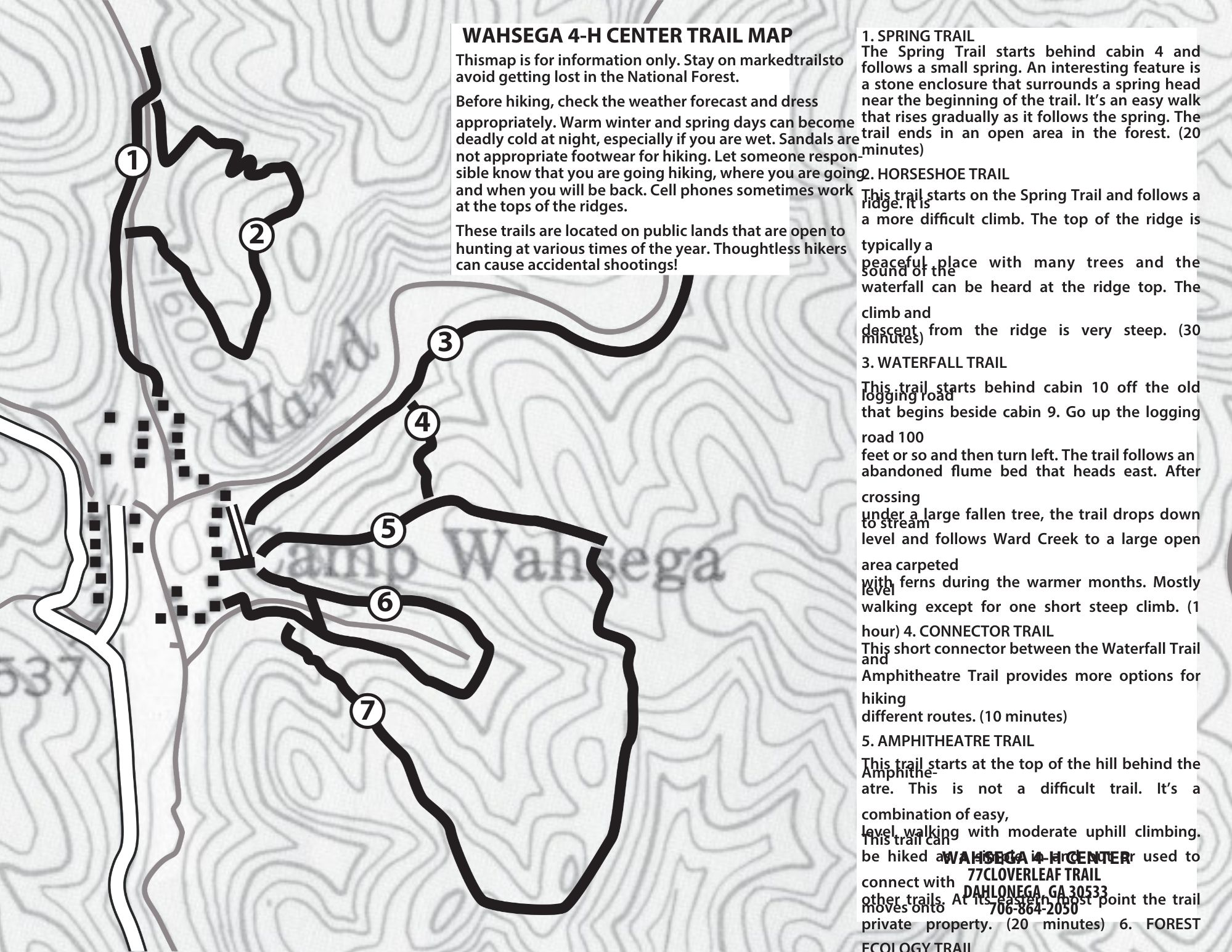
- Trails at Wahsega


Contact Us
Wahsega 4-H Center
77 Cloverleaf Trail
Dahlonega, GA 30533
Phone: (706) 864-2050
Email: wahsega@uga.edu
Becoming Wahsega
Our story begins in 1867 when a young man names Joesph McDougald purchased acerage to farm in a valley on Ward Creek in Lumpkin County. Joseph and his wife Nicy farmed and raised their 13 children in the area Wahsega 4-H Center is now located. In her memoir, Joseph’s granddaughter, Callie Freeland, recalls the family home stood near where cabin 17 is located now. The home was a story and a half log structure with a separate kitchen connected to the main home by a breezeway.

The photograph above shows Joseph and Nicy McDougald with soome of their very large family standing in front of the McDougald home. The main house is to the right and the kitchen is to the left. The breezeway connecting the two has wisteria growing on it.
The McDougald farm was largely self-sufficient, growing corn and wheat, and raising cattle, sheep and hogs. Wahsega’s Pollywog Pond was the location of one of the family’s cornfields. They sheared their sheep, carded the wool and spun it into thread. Nicy kept a loom in the upstairs portion of the house to make cloth. She was an accomplished seamstress, making all the clothing for her large family including suits and dresses. She also made all their blankets.
The Mcdougalds operated a mill at the falls on Ward Creek where they ground their wheat and corn into cornmeal and flour. The mill had an overshoot waterwheel with a wooden flume to bring water from near the top of the falls to the waterwheel below. While the structure itself no longer stands, one of the original mill wheels has been preserved at Wahsega near Pavilion 4.

The photograph above shows Joesph McDougald standing on the race of his mill. It was a cold winter day when ice had frozen on the mill race. The mill wheel and corner of the mill house can be seen in the bottom left corner of the picture.
Nicy McDougald passed away in December, 1920 and Joesph shortly thereafter in May 1921. They are buried at Mt. Zion church, located directly across from the entrance to Camp Frank D Merrel, where Joseph was a deacon for many years. Their daughter Minervia and her husband John Collins inherited and lived in the Ward Creek Valley until 1930 when the family sold the 399.45 acre tract to the US government. In tribute to the family who cleared the valley where Camp Wahsega is located, every summer there is a McDougald family group each week of summer camp.
The Civilian Conservation Corp formed Camp F-11 in the Ward Creek Valley and stationed World War 1 veterans there as Company 2417-VW from 1933 to 1937. Much of the character and charm that Wahsega 4-H Center is known for today is directly due to the CCC .It was their skilled craftsmanship that produced the peeled chestnut, board and batten cabins and the dining hall, with its beautiful, exposed beam arched interior, that are still in use today. They are also responsible for the stonework seen throughout camp. The stones were brought down from a quarry the company operated that was located near Upper Black Falls at what is now US Army Camp Frank D Merrell. The Pollywog Pond is also compliments of Company 2417-VW. The pond was built with a Cletrac tractor and was completed on May 6, 1935. The pond was originally used for fishing and stocked with rainbow trout.

The photo above shows the barrick style buildings the CCC occupied prior to the cabins that are still used at Wahsega today were built on the property.
As the United States began involvement in World War II, the CCC disbanded. Camp F-11 was officially unoccupied on 6/30/1937 and the buildings were turned over to the Forest Service. The Forest Service Record of Occupancy outlining the evacuation of Camp F-11 shows Georgia 4-H first leased the camp via special use permit form August 16-September 15, 1937.

Pictured above is a Forest Service document showing the evacuation date and plans for CCC camp F-11.
The Works Progress Administration (W.P.A) organized and staffed a recreational camp for underprivileged children at the former CCC camp. Little is known about the camp itself. In 1983, a framed document was found behind an ice machine in the dining hall. According to this document there were upwards of 5000 participants from 1939-1942.

U.S. Forest Service records show that the Georgia Agricultural Extension Service resumed using Camp Wahsega as a 4-H youth camp in under special use permit in 1943. It is estimated that the summer camp occupancy was around 125 participants at that time.
One of the World War I veterans stationed at CCC Camp F-11 was Bill Casteel. He served as foreman of the road crew. He and his crew were building Winding Stair Gap Road when he met his wife, Effie. Bill returned to Camp Wahsega in 1946 as the first resident camp director while Effie managed the dining hall. In an interview in the 1990’s Effie recalled she and her kitchen staff cooked on large coal stoves and washed and dried all the dishes by hand. “Ice had to be brought in daily and stored in huge ice boxes that were our only means of refrigeration. We had to chip the ice with ice picks for the big pitchers of iced tea.” There was no electricity at Camp Wahsega during this time. The campers picked blackberries around camp, and their favorite dessert was Effie’s blackberry cobbler.

Pictured above is Effie Casteel with members of the dining hall staff at Wahsega with freshly made blackberry cobblers.
Just shy of the depression era and as is Appalachian culture, little was wasted during these days. A local family would drive to camp in their steer pulled wagon to pick up scraps from the kitchen to feed their hogs.

Pictured above is the steer pulled wagon used by the Black family to take haul scraps from the Wahsega dining hall.
In 1951 plans were made for a rec hall and other camp repairs. There were many setbacks and delays. It was 1958 before the rec hall that stands at Wahsega 4-H Center today was approved and construction began.

From 1952 to 1958 US Army Rangers leased Camp Wahsega nine months of the year (excluding June, July, August when the camp was used as a 4-H summer camp) It was a platoon of the 534th Signal Construction Company who ran new telephone lines to Wahsega.

The photo above shows US Army Rangers in front of a Wahsega cabin on a sunny February day in 1955.
On July 26, 1963 the original girl’s bathhouse burned. The building was soon replaced by a concrete block building with a composite roof, making this the first, and to date the only non-wooden building on Camp Wahsega. In 2019 the volunteers from UNG Honors Program painted a mural depecting a pond scene featuring native wildlife.

In 1965, camper from Crawford County named Kathryn Andrews came to camp at Wahsega. She was killed in a tragic car accident in 1966. In tribute to her memory, a bell atop a stone pilar was placed across the creek form the dining hall. On the pilar is a plaque with a poem Kathryn wrote about Wahsega. This bell is still in use today. It rings to signify time to change activities for every group that visits Wahsega 4-H Center.

In 1988 Wahsega 4-H Center celebrated 50 it’s 50th annivesary. Beloved camp leaders’ “Papa Walt” and “Momma Lou” Chislom were resident managers of Wahsega when the center celebrated it 50 year anniversary. Just like the Casteel’s before them, couple managed the camp and its dining facility from 1972-1990.

In the spring of that same year, Papa Walt partnered with Diane Davies, State Coordinator for the 4-H Environmental Education Program, to bring a new environmental education program for public schools to Wahsega. This new Georgia 4-H EE program uses the outdoors as a classroom to provide overnight academic field studies for students in public, private, homeschool and home-based learning in grades K-12. Walt Chisolm’s contributions to Wahsega were great. Perhaps his most significant contribution to Wahsega was his dedication to the success of the EE program as it made Wahsega operational year-round.

Today, the traditional Georgia 4-H summer camp program is still going strong, the then fledgling Georgia 4-H EE program, now brings more youth to Wahsega than summer camp as it operates September thru May to accommodate school groups the entire academic year.



The University of Georgia College of Agricultural and Environmental Sciences (working cooperatively with Fort Valley State University, the U.S. Department of Agriculture, and the counties of Georgia) offers its educational programs, assistance, and materials to all people without regard to race, color, religion, sex, national origin, disability, gender identity, sexual orientation or protected veteran status and is an Equal Opportunity, Affirmative Action organization.