Download PDF for Print
Overview
Introduction
Georgia is one of the most biologically diverse states in the nation, ranking 2nd in amphibian species, 3rd in freshwater fish species, and 7th in reptile species. Wildlife Judging challenges 4-H youth to learn about Georgia wildlife species and habitat management practices for conservation success. 4-H competitions are held annually at the area, state, and national levels.
Youth participating in the Georgia 4-H Wildlife Judging contest will be able to:
– Describe characteristics of common wildlife species of Georgia.
– Identify common wildlife species of Georgia by examining specimens (pelts, skulls, feathers, calls, tracks, etc.).
– Explain different wildlife management practices (population survey, removing invasive species, etc.).
– Choose best management practices for a given species based on a scenario and site.
– Develop a species management plan based on a scenario and site.
The Georgia 4-H Wildlife Judging Contest is based on the National 4-H Wildlife Habitat Education Program (WHEP) contest. All content for the contest is derived from the National WHEP manual (6thedition; 2024), available on the Georgia 4-H website and in the 4-H Staff Only Files within the 4-H Enrollment system.

Eligibility
Membership classifications and contest divisions are defined as:
– Juniors: 4th – 8th grade
– Seniors: 9th -12th grade
Eligibility is determined by the grade level during the current school year. Refer to the Georgia 4-H Membership & Eligibility on the Georgia 4-H website document for more information.
Area contests are held throughout the state. Counties may compete at multiple area contests with different youth competitors. Youth cannot compete in multiple area contests in the same 4-H program year. There is no limit to the number of Junior and Senior competitors a county may bring to an area contest. Youth will complete Activity 1-A, 1-B, 2, and 3-A at the area contests.
– Individual scores are calculated from Activity 1-A, 1-B, and 2.
– Team scores are calculated from the top three scoring youth from Activity 1-A, 1-B, and 2 plus the group 3-A.
See below for more information.
For all contests, a minimum of 3 participants comprise a team. Counties may have up to 5 teams per division (Junior and Senior). There is no maximum number of youth that can be on a team. Typically, counties choose to divide their youth into smaller teams so that each contestant can actively participate in the development of the management plan. Counties cannot mix divisions to comprise a team. All members of the Junior team must meet the Junior grade requirements, and all members of the Senior team must meet the Senior grade requirements.
For all contests, all youth compete as individuals and earn an individual score. Counties will also designate teams of youth (minimum 3 youth per division) to earn a team score. Youth not assigned to a county team will be assigned an “at large” wild card group so that they may write a management plan.
– Area Contests: The “at large” group’s management plan is great practice for youth to demonstrate their skills and knowledge. Individual scores are not calculated from this activity at the area contest.
– State Contest: Having individuals join an “at large” group is imperative because each youth will present individual oral defense of the plan (which is individually scored). Since these youth are not part of a team, only their Activity 3-B (Oral Defense of Wildlife Management Plan) score will be part of their individual score.
Depending on the number of individual contestants, the Georgia 4-H Specialist may choose to create multiple at-large wild card teams.
Georgia 4-H Contest
An area Georgia 4-H Wildlife Judging Contest has four activities. Activities 1-A, 1-B, and 2 are individual activities. Activity 3-A is a team activity. The state Georgia 4-H Wildlife Judging Contest has the previous four activities as well as 3-B, which is an individual activity.
The activities are:
– Activity 1: Wildlife Challenge – consists of a Written Knowledge Test (1-A) and Specimen Identification (1-B).
– Activity 2: Wildlife Management Practices
– Activity 3-A: Wildlife Management Plan
– Activity 3-B: Oral Defense of Wildlife Management Plan
The National WHEP manual identifies 14 ecoregions and identifies a set of species for each. The manual also identifies two special area considerations: Urban and Wetlands.
For the Georgia 4-H Wildlife Judging contest, only the Southeast Mixed and Outer Coastal Plain Forest ecoregion is used. The Wetlands and Urban ecoregions are not applicable to the Georgia 4-H contest.
For Senior competitors, all 22 species associated with the Southeast Mixed and Outer Coastal Plain Forest ecoregion apply. These are listed on page 61 of the National WHEP Manual:
1. barred owl
2. loggerhead shrike
3. mourning dove
4. northern bobwhite
5. prothonotary warbler
6. red-cockaded woodpecker
7. red-eyed vireo
8. wild turkey
9. wood duck
10. coyote
11. eastern cottontail
12. eastern fox squirrel
13. raccoon
14. white-tailed deer
15. wild pig
16. American alligator
17. eastern indigo snake
18. gopher tortoise
19. channel catfish
20. largemouth bass
21. American bumble bee
22. monarch butterfly
For Junior competitors, only 10 species apply:
1. barred owl
2. mourning dove
3. northern bobwhite
4. eastern cottontail
5. eastern fox squirrel
6. white-tailed deer
7. American alligator
8. gopher tortoise
9. largemouth bass
10. American bumble bee
General Rules
All contestants abide by the Georgia 4-H Code of Conduct and Georgia 4-H Code of Ethics on the Georgia 4-H website.
All contestants must provide pencils, yellow highlighters, color pencils (for the wildlife management plan), and clipboards. No storage clipboards are allowed. Clipboards should not contain blank paper, notes, guidebooks, etc.
Contestants are not allowed to have electronic devices of any kind at the contest site. This includes, but is not limited to, cell phones, MP3 players, etc. If a contestant is seen with electronic devices during the contest, that person and team may be disqualified immediately.
Contestants are not allowed to have backpacks in the contest area. Bags for medical reasons should be discussed with the Georgia 4-H Specialist coordinating the contest before the event.
Contestants work independently on the individual activities. Contestants are not allowed to talk during the individual activities.
Questions are not allowed during the contest except for those related to the contest procedure. Questions should be directed to contest administrators.
Anyone cheating will be disqualified at the discretion of the Georgia 4-H Specialist and Extension Wildlife Specialist.
Youth enter their answers for Activity 1 and Activity 2 into the electronic scoring system during the competition. The judges record their scores for Activity 3-A and 3-B onto a scoresheet, and these scores are entered by the contest event staff. The Georgia 4-H Specialist and Extension Wildlife Specialist review and certify the results before the announcement of winners. The decision of the Georgia 4-H Specialist and Extension Wildlife Specialist are final. After the event, individual and team scores are made available in the 4-H Event Registration system. Contest score sheets will not be distributed after the contest. Team management plans will be electronically distributed to County Extension Offices no later than one month after the contest.
Youth needing to leave the contest early needs to coordinate this request through their County Extension Office with the Georgia 4-H Specialist at least 3 weeks before the contest. In certain circumstances, this request may not be granted.
Because competitors spend time transitioning from various sites, stations, etc., during the contest, it is imperative that the youth competitors and their adult chaperones act in accordance with the Georgia 4-H Code of Ethics. This includes refraining from talking, sharing notes or observations, answer sheets, etc. If adult chaperones are providing transportation between sites/stations, they should not discuss the contest or wildlife-related content with the youth.
Accommodations
The University of Georgia is an Equal Opportunity Institution. Youth requiring a reasonable accommodation or language access services to participate in Georgia 4-H Wildlife Judging should request these accommodations through their local County Extension Office to the Georgia 4-H Specialist at least three weeks before the competition.
The Reasonable Accommodation(s) Request Form is found here:
https://secure.georgia4h.org/documents/AccommodationRequestForm.pdf
The Georgia 4-H Accommodation Guidance Tool is in the 4-H Staff Only files by following: 4-H Enrollment – Shared Files – Staff Only – Accommodations for Youth – Accommodations for Youth with Special Needs – Georgia 4-H Accommodation Guidance Tool & Request Form.
This tool can help coaches and Extension staff determine what accommodation may be needed and how to request it. For example, youth can request an accommodation for assistance with reading information, recording responses, and/or typing answers into the electronic scoring platform.
Georgia FFA and 4-H Statement of Relations
Refer to the current version of the Georgia FFA and 4-H Statement of Relations available on the Georgia 4-H website regarding a youth’s participation in similar contest. A student may participate in both FFA and 4-H simultaneously. However, a student is not allowed to participate in activities considered “same” to both groups in the same “project year.” The Statement of Relations defines the “project year” as July 1 to June 30. The Statement says that annually the State FFA Advisor and State 4-H Leader will meet and announce the list of activities considered “same” for the coming year. Currently, Wildlife Management/Judging is considered the “same.”
Activity 1: Wildlife Challenge (50 Points)
The Wildlife Challenge consists of two parts: a written knowledge test (Activity 1-A) and specimen identification (Activity 1-B). Content to prepare for the Wildlife Challenge activities is throughout the National WHEP Manual including:
– Concepts and Terms (pp. 17-27)
– Southeast Mixed and Outer Coastal Plain Forest (pp. 58-61)
– Wildlife Species (selected pp. 69-220)
– Wildlife Management Practices (pp. 221-252)
– Glossary (pp. 256-258)
Only species of the Southeast Mixed and Outer Coastal Plain Forest ecoregion (p. 59) are used for the Georgia 4-H Wildlife Judging Contest. Seniors should know all 22 species for the Southeast Mixed and Outer Coastal Plain Forest. For Junior competitors, only 10 species apply.
Junior competitors will have 35 test questions and 15 specimens to identify.
Senior competitors will have 30 test questions and 20 specimens to identify.
Each question/specimen is worth 1 point.
Contestants have 30 minutes to complete Activity 1-A and 30 minutes to complete Activity 1-B. After recording their answers on the scorecard, contestants enter their responses into an electronic scoring platform. The input of answers into the electronic scoring platform is not timed and occurs after the 30 minutes allocated for recording their responses on their scorecard. Depending on contest logistics, the answers may be inputted into the electronic scoring platform after each activity throughout the contest or at the end of the contest when all activities have been completed.
The objective of Activity I is to demonstrate knowledge of wildlife identification, ecoregion species, wildlife management concepts, terminology, wildlife management practices, and the biology and ecology of wildlife species.
Activity 1-A: Written Knowledge Test
For the written knowledge test, contestants are given a printed copy of a multiple-choice test. Each question has up to four options.
An example question might be …
Which bird call sounds like “Who cooks for you? Who cooks for you all”?
A. barred owl
B. mourning dove
C. northern bobwhite
D. wild turkey
Answer: A – barred owl; found on page 78 of the National WHEP Manual
All question content for the written knowledge test is derived from the National WHEP Manual from these sections: Concepts and Terms (pp. 17-27), Southeast Mixed and Outer Coastal Plain Forest (pp. 58-61), Wildlife Species (selected pp. 69-220), Wildlife Management Practices (pp. 221-252), and Glossary (pp. 256-258).
Activity 1-B: Specimen Identification
For the specimen identification, contestants are presented with a wildlife specimen and must identify the wildlife species. Contestants have 30 minutes to identify all the species and record responses on their scorecard.
Participants may be asked to identify an animal by a specimen (pelt, skull, wing/feather, mount, fish in jar with preservative fluid, insect in resin, etc.), portion of a specimen, photo, animal sign (track, scat, etc.), sound/call, or distinctive habitat photo (ex. photo of a gopher tortoise burrow or wood duck nesting box). Contest coordinators do not select specimens intending to trick contestants. For example, a skull (as opposed to a femur or rib bone) would be provided. Typically, adult-sized specimens would be selected (e.g. a juvenile eastern cottontail skull would be nearly impossible to source and potentially identify). There may be outliers (e.g. a juvenile American alligator skull looks very similar to an adult), but they would be extremely obvious. Some of the species exhibit sexual dimorphism, where physical characteristic differences exist between males and females, such as size, color, or shape, etc. In this situation, the coordinators would likely indicate if contestants are identifying males or females.
Examples of wildlife specimen identification are included below.


Although stations may be located outdoors for Activity 1 at the national competition with questions related to various habitat features (e.g. what successional stage is represented by the site you see?), this does not occur at any area or state Georgia 4-H competition.
When identifying species in the Specimen Identification, the correct spelling, capitalization, and punctuation must be used to receive credit. The correct spelling, capitalization, and punctuation for the species in the Southeast Mixed and Outer Coastal Plain Forest ecoregion are listed on page 61 of the National WHEP Manual.
Juniors are provided a handout (see Appendix A) at the competition. This is the exact handout provided. The word bank includes possible wildlife species and variations of the spelling of the species. Both correct and incorrect spellings as well as correct and incorrect species are listed. Juniors can reference this word bank because the correct answers to the specimen identification are provided. However, they must correctly enter the name of the wildlife species (including correct spelling, capitalization, and punctuation) into the electronic scoring system.
Activity 2: Individual On-Site Recommendation of Wildlife Management Practices (50 Points)
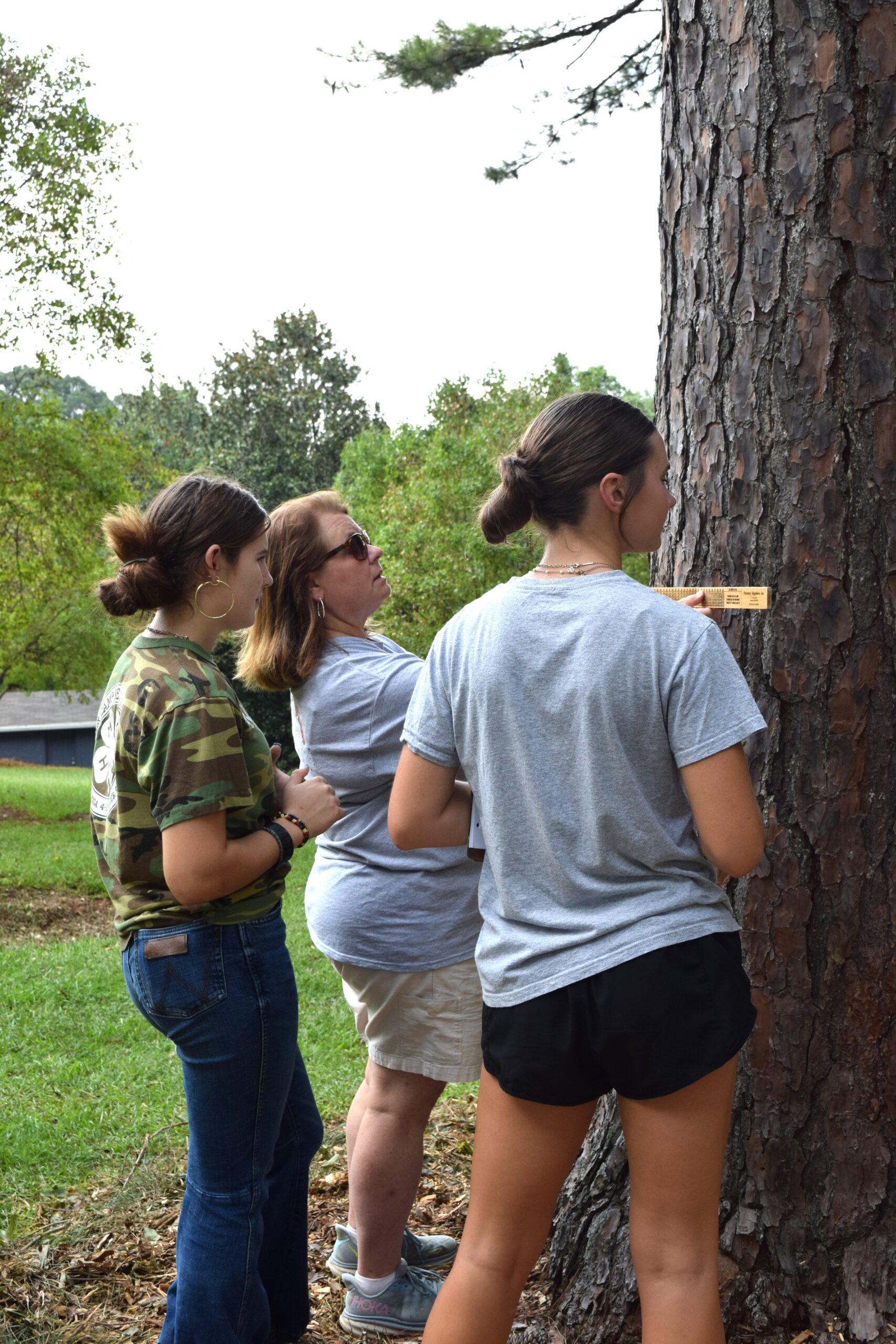
Activity 2 involves recommending Wildlife Management Practices (WMPs) to manage wildlife and habitat on a given site. Contestants are provided an outdoor site (typically designated by flagging tape) and a scenario.
Juniors are asked to select management practices for 4 species (selected by the contest coordinators) in the Southeast Mixed and Outer Coastal Plain Forest ecoregion. For Junior competitors, only the ten species apply. The correct number of WMPs needed for each species is shared with the Juniors. For example, check 7 WMPs for Species 1, for the eastern cottontail.
Seniors are asked to select management practices for 6 species (selected by the contest coordinators) in the Southeast Mixed and Outer Coastal Plain Forest ecoregion. All 22 species are eligible to be the focal species. Seniors are not provided the number of WMPs needed for management.
Youth must evaluate the site and read the scenario to determine if a practice is needed. For example, typically, a wildlife or fish survey is a practice checked for all species. However, if the scenario indicates a survey has recently been completed, this practice does not need to be checked. Barred owls need snags for reproduction. However, if the site has adequate snags, then the practice of creating snags would not be selected.
Contestants have 30 minutes to select the WMPs by placing an ‘X’ for each recommended practice for each species. After recording their answer on the scorecard, contestants enter their responses into an electronic scoring platform. The input of answers into the electronic scoring platform is not timed and occurs after the 30 minutes allocated for recording their responses on their scorecard.
A list of all possible practices for each species is found on page 59 of the National WHEP manual.
Management recommendations in Activity 2 should consider each species listed separately. The WMPs should be recommended as if each species was the only species (focal species) considered on the site.
Prior to starting Activity 2, each contestant is given a printed copy of a scenario for the outdoor site. Youth may use pencils and/or yellow highlighters to make notes on the scenario page.
An example scenario is included below:
Your family recently purchased this 100-acre lake-front property as a place where the family can vacation. The site includes the lake and the forested land surrounding the property. Currently, there are no buildings on the property, but as the lake owner, you are responsible for the spillway and levee. As the young biologist in the family, your family has asked that you plan the appropriate management actions to meet your family’s vision. Your grandparents are interested in birds of prey, and thus, your goal is to benefit owls and similar species. Because those birds rely on small mammals, the family is concerned about the number of deer and how it may impact the vegetation. You are interested in increasing fox squirrels to benefit other large birds of prey such as eagles. Your family really enjoys fishing, so you would like to improve the largemouth bass population for future fishing opportunities. However, some preliminary seine sampling you just completed revealed that there are no recently hatched largemouth bass and lots of intermediate largemouth bass in poor condition. There is no sign of livestock on the property, the spillway is in good condition, and there is no current system in place to control the water levels. Given all this information, your goal is to identify management practices to incorporate over the next year to restore and/or increase native wildlife and fisheries habitat for the benefit of the 4 species listed below.
Species 1: barred owl – check 6 practices
Species 2: white-tailed deer – check 8 practices
Species 3: eastern fox squirrel – check 9 practices
Species 4: largemouth bass – check 5 practices
Remember, Seniors will have 6 species and not be provided the number of practices to select.
This is an individual activity, so no talking or collaboration among team members is allowed.
To calculate the total score for Activity 2:
| Step One
(Number of correct answers
marked by 4-H’er)
Minus
(Number of incorrect guesses) |
Step Two
Divided by the (total number of possible correct answers) |
Step 3
Multiplied by 50 |
For example, a WMP score sheet key includes 20 items that should be checked. The contestant marks 15 correct answers. Therefore, they fail to mark 5 correct answers. There were no incorrect guesses. The contestant’s score is calculated as [(15 – 0 = 15) / 20 = 0.75] X 50 = 37.5 points. Another scoring example could be a WMP score sheet key includes 20 items that should be checked. The contestant marks 15 correct answers but also marks 10 incorrect guesses. The contestant’s score is calculated as [(15 – 10 = 5) / 20 = 0.25] X 50 = 12.5 points. No negative scores will be assigned. The minimum individual score on Activity 2 is 0.
Activity 3-A: Written Wildlife Management Plan (125 Points)
The Written Management Plan is a team event in which team members discuss, consider, and provide written recommendations that address current conditions and objectives regarding wildlife populations and habitat on a specified property. Contestants are provided with an outdoor site (typically designated by flagging tape) and a scenario that describes the property, current conditions, and landowner objectives.
A copy of the scenario is provided to all contestants, and youth may use pencils and/or yellow highlighters to make notes on the scenario page. Youth are allowed to talk to their team members during the entire portion of this activity. During this portion of the competition, youth will not have their scorecards. Teams will be given a packet of materials (see below) for use with these stations. Junior teams use the template (see Appendix B) and answer the questions about 1 species (selected by the contest coordinator).
The Junior focal species are one of the following species: the barred owl, eastern cottontail, American alligator, largemouth bass, or American bumblebee. No other species would be chosen. Juniors do not prepare a formal management plan; they complete the questions on the template. Each Junior contestant will be given one sheet of paper to write notes on while observing the site. Teams turn in the one template with the answers recorded on the template. For Seniors, the plan will address 2 species (selected by the contest coordinator) to be announced during the activity. The 2 focal species are selected from the 22 listed for the Southeast Mixed and Outer Coastal Plain Forest ecoregion. They will consider both species in the one plan.
Compromises may likely be part of the plan (i.e. installing a food plot for one species could create an increase in population for another species). Each Senior contestant will be given one sheet of paper to write notes on while observing the site. For the state contest, each Senior contestant can keep their notes page so that they can study before the oral defense. Senior teams are given three sheets of paper. Two of these sheets are for writing the plan in paragraph format. The third sheet is for sketching a map of the property illustrating where practices should be implemented. Youth may only write on one side of each piece of paper. Teams turn in three sheets of paper as a team: two pages of a written plan and a one-page sketch mapping the property illustrating where practices are implemented.
Teams may use pencils only, no pens. Colored pencils are allowed for the sketch if desired. Contestants have 1 hour and 20 minutes to complete this activity. Youth are allowed to talk to their team members the entire time. The first 40 minutes is spent outdoors, where contestants read the scenario, observe the property, and make notes. Then, the teams transition to a location away from the site. Each team has an individual team table and chairs (one per team member). Teams work together to create their written plan to be submitted for evaluation at the end of this time period. Teams may not transition early. If a team is satisfied with their outdoor observation, they may begin to write their plan outside at the site. Youth must evaluate the site and read the scenario to determine if a practice is needed.
For example, typically, a wildlife or fish survey is a practice checked for all species. However, if the scenario indicates a survey has recently been completed, this practice does not need to be checked. Barred owls need snags for reproduction. However, if the site has adequate snags, then the practice of creating snags would not be selected. When coaching Seniors in creating a plan, using the Junior template is a great guide for practicing, ensuring they are including the correct information.
Remember, they are not provided this template at the contest. A strong tip is for these youth to think about “what-why-how” when describing their intended actions – what management practice are they selecting, why are they selecting it, and how it will affect the ecosystem and two focal species.For example, gopher tortoises eat grasses, legumes, and fruits. When observing a site, the contestants notice a lot of non-native, invasive species (like kudzu) that are preventing native grasses from growing. Therefore, the team may recommend:
What: controlling nonnative invasive vegetation
Why: because the observed kudzu is reducing habitat quality by limiting herbaceous diversity and could be difficult for tortoises to dig burrows
How: controlling nonnative invasive vegetation (removing it) would likely provide more diverse food options for tortoises, potentially increasing their population. Additionally, many times a wildlife or fish survey is recommended to monitor the potential increase or decease in the population for the selected species. Senior contestants are especially encouraged to use specific details about what type of survey they would conduct and the frequency. For example, contestants may earn more points if they indicate that they would specifically conduct point counts monthly for the next six months to monitor the red-eyed vireo population, as opposed to just saying they would conduct a wildlife survey. On each species page in the national WHEP manual, suggested survey types are listed. More detailed explanations of surveys are also listed on pp. 247-248.
Note for the State Contest: The oral defense (Activity 3-B) is included in calculating a contestant’s overall individual score. Therefore, every youth must complete a Written Management Plan (Activity 3-A) to complete the oral defense (Activity 3-B). Counties with fewer than 3 Senior youth will have then assigned to the state “at large wild card” team so that they can write a management plan to present their oral defense. Wild card members will present their oral defense on the plan created by their “wild card” team. This is a group activity, so talking and collaboration among team members is permitted during Activity 3-A. However, conversations with others outside the team are not allowed. Prior to starting Activity 3-A, each contestant is given a printed copy of a scenario for the outdoor site. An example scenario is included below:
Your family recently purchased this lake-front property as a place the whole family can get together during vacations. This 200-acre property includes the lake, the forested land surrounding the property, and a power line corridor. There are currently no structures on the property. As the young biologist in the family, your family has asked that you to create a wildlife management plan to meet the vision of the family as a whole. In particular, your parents are really interested in pollinators, because they believe if they are doing well, many of other wildlife will also benefit. Because of that, your goal is to increase the number of American bumble bees on the property. Importantly, although there are livestock in the area, it looks like this property has never had any livestock grazing on it.
One or two judges evaluate plans using the scoring rubrics (see Appendix C and D). The scores are averaged (if evaluated by two people) to determine the final team score. Teams may earn up to 125 points on Activity 3-A. The management plan score is part of the team score but not an individual’s score.An example aerial sketch/map is included below. This is Part 5 on the Junior Wildlife Management Plan Template. Seniors are provided 1 blank piece of paper to draw a map.
Special Notes for Activity 1-A, Activity 2, and 3-A
Below are some special notes and additional information that is applicable for Written Knowledge Test (Activity 1-A), Wildlife Management Practices (Activity 2) and Wildlife Management Plan (Activity 3). Nonnative Invasive Plants: There are numerous nonnative invasive plants within the Southeast Mixed and Outer Coastal Plain Forest ecoregion. For the Written Knowledge Test (Activity 1-A), questions about nonnative invasive plants will only be about those listed on page 58 of the National WHEP Manual. Some of the species listed in the National WHEP Manual (e.g., popcorn tree) may have multiple names (e.g. Chinese tallow tree). The Georgia contest will not test contestants about these additional names. This information is shared merely to help coaches and youth understand the broader context of the material and to highlight where additional research or reference materials may be helpful during preparation. Conservation Easement: A conservation easement is a legal agreement between a landowner and a land conservation organization or government agency that places permanent restrictions on what can be done on a property. There are 7 species within the Southeast Mixed and Outer Coastal Plain Forest ecoregion that could have a conservation easement apply to them: loggerhead shrike, northern bobwhite, red-cockaded woodpecker, eastern indigo snake, gopher tortoise, American bumble bee, and monarch butterfly. For the purposes of the Georgia contest, unless the scenario states a conservation easement is already established, this practice should always be chosen for the 7 applicable species. More information can be found on page 222 of the National WHEP Manual. Control Nonnative Invasive Vegetation: Many nonnative invasive vegetation can be detrimental to wildlife habitats because they out-compete native species for sunlight and nutrients. Additionally, they do not provide suitable cover, structure, or food for wildlife. This management practice is applicable to ALL but 4 species (wild pig, American alligator, channel catfish, and largemouth bass) within the Southeast Mixed and Outer Coastal Plain Forest ecoregion. For the purposes of the Georgia contest, this practice should always be chosen for the 18 applicable species. If aquatic vegetation (e.g. hydrilla, water hyacinth, etc.) is problematic in a lake or pond, then control aquatic vegetation should be recommended for the channel catfish and/or largemouth bass. More information can be found on page 222-23 of the National WHEP Manual. Harvest: The increase and decrease harvest population practices are only applicable to certain fish and game species within the Southeast Mixed and Outer Coastal Plain Forest ecoregion: northern bobwhite, wild turkey, coyote, eastern cottontail, eastern fox squirrel, raccoon, white-tailed deer, wild pig, channel catfish, and largemouth bass. Both practices (increase harvest or decrease harvest) would be applicable to all species previously listed, with a few exceptions below: Northern bobwhite populations have declined across much of their range due to habitat loss, fragmentation, and changes in land use. Since northern bobwhites have limited ability to withstand increased harvest pressure, wildlife agencies focus on conservative harvest regulations and habitat management rather than increasing harvest to allow populations to stabilize or recover. Therefore, only decrease harvest is applicable to this species. Wild pigs are a nonnative invasive species with high reproductive rates and no natural population controls in many areas. Increasing harvest is used to reduce population growth and limit damage to native habitats, wildlife, crops, and soil resources. Therefore, only increase harvest is applicable to this species. Mourning doves are managed by the U.S. Fish and Wildlife Service in partnership with state agencies under the Migratory Bird Treaty Act. Management emphasizes regulated hunting, population monitoring, and habitat practices that maintain open fields and adequate seed sources to support healthy populations. While mourning doves are harvested in Georgia, the increase or decrease harvest practice is not applicable to this species, because harvest decisions are designated at a national scale rather than local scale.
Activity 3-B: Oral Defense (25 Points)
Activity 3-B is only for Seniors attending the state contest. The Oral Defense is an individual event where contestants answer questions about the Wildlife Management Plan (developed during Activity 3-A). Thus, it is important that each team member actively participates in preparing the written plan. Comprehensive knowledge of the written plan is necessary to successfully respond to judges’ questions about the team’s plan. Team members are called individually into a room or outdoor space with one or two judges, where they are asked a series of standard questions to test the individual’s knowledge of the team’s plan. Senior competitors have up to two minutes to answer questions asked by the judge(s). Below are the questions the judge(s) could ask the competitor. The contest coordinator will pre-select three questions that all Senior competitors will answer at the contest:
– What wildlife management practices did you incorporate into your plan, and why did you choose these practices?
– Explain any compromises you had to make in developing your plan.
– Based on the wildlife management practices you incorporated, which practice might be the most challenging, and why?
– Are there any wildlife management practices you incorporated that could be mutually beneficial for both species? How so?
– What do you consider the most limiting factors for both species?
– Explain two methods you would use to determine the effectiveness of your team’s plan. Upon entering the space, the judge begins the timer and asks the first question. After the competitor answers, the judge will continue with the second and third questions. If a competitor struggles to fully answer, the judge may ask a follow-up or probing question (e.g., what are the habitat requirements for coyotes?). The intent is to give the youth an opportunity to expand their response and demonstrate more knowledge, which can result in a stronger score. Youth should be coached to answer the questions efficiently and succinctly in the allocated time. The time is the total time allowed, not the time per question. Sometimes, teams will have members work on different components of the management plan (i.e., one youth writes about species requirements, one youth writes about management practices, etc.) as a strategy. It is extremely important that all youth are familiar with the scenario and their team’s final submitted plan because they may be asked broad questions that do not necessarily directly relate to their “part” of the plan. Although youth will strictly be asked the questions above, typically contestants that score well are able to incorporate additional details in their responses. Stronger answers will address 4 main components as it relates to the question asked:
What species are we managing for?
What do they require (e.g., resources)?
What does the management practice do for that resource?
What is the expected results (benefit/negative) for the species?
For example, a student has a scenario to increase more eastern cottontail. They were asked the question: “What wildlife management practices did you incorporate into your plan, and why did you choose these practices?” A high scoring answer would state something similar to the following: We are trying to increase the number of eastern cottontail. The eastern cottontail likes dense shrub cover for food and escape cover. Because there was very little shrub cover on the property, we planted shrubs to provide food and escape cover which should benefit the eastern cottontail and increase the abundance of them on the property. One to two judges evaluate the oral defense using the scoring rubrics (see Appendix E). If two judges are present, their scores are averaged to determine each contestant’s final oral defense score. Note: In many 4-H judging/evaluation contests, youth present a set of ‘oral reasons’ – placing a class of items and defending their placings. The oral defense in the Georgia 4-H Wildlife Judging contest differs from other contests. Wildlife Judging competitors respond to the standard questions, and their responses are evaluated by judges using the rubric.
Area Scoring
Individual Scoring
Activities 1 and 2 are scored individually, with individual scores contributing to their team’s score (if applicable):
Activity 1: Wildlife Challenge (maximum of 50 points)
Activity 2: Wildlife Management Practices (maximum of 50 points)In case of a tie following tabulation of individual contestant scores, the tie scores are broken in descending order by:
– Activity 2: Wildlife Management Practices
– Activity 1: Wildlife Challenge
Team Scoring
Activity 3-A (Written Management Plan) is scored as a team effort (maximum of 125 points) and is only considered for the team score. The Management plan is not a part of an individual’s score. Counties cannot mix divisions to comprise a team. All members of the Junior team must meet the Junior grade requirements, and all members of the Senior team must meet the Senior grade requirements. For teams of four or more members, the top three individual scores within a team count toward the total overall team score, regardless of the number of team members. For teams of three members, all scores will count. In case of a tie following tabulation of teams’ scores, the tie scores will be broken in descending order by:
– Activity 3-A: Written Management Plan
– Summation of top 3 contestants’ scores from Activity 2: Wildlife Management Practices Should a tie remain, the contest coordinators (Georgia 4-H Specialist and Extension Wildlife Specialist) will determine a strategy to select the winner.
Scoring Examples
Scoring Example for an Individual
A perfect individual score at an area contest is 100 points.
| Activity |
Contestant 1 |
Contestant 2 |
Contestant 3 |
Contestant 4 |
| Activity 1-A |
8 |
20 |
10 |
20 |
| Activity 1-B |
10 |
15 |
10 |
15 |
| Activity 2 |
10 |
30 |
25 |
40 |
| Total |
28 |
65 |
45 |
75 |
| Placings |
4th |
2nd |
3rd |
1st |
Scoring Example for A Team
A perfect team score at an area contest is 425 points:
300 points from 3 individuals + 125 points from the management plan.
| Activity |
Contestant 1 |
Contestant 2 |
Contestant 3 |
Contestant 4 |
| Activity 1-A |
8 |
20 |
10 |
20 |
| Activity 1-B |
10 |
15 |
10 |
15 |
| Activity 2 |
10 |
30 |
25 |
40 |
| Total |
28 |
65 |
45 |
75 |
| Top Three |
Drop |
2nd |
3rd |
1st |
| Activity |
Total |
| 3 High Individual Team Scores (75 + 65 + 45) |
185 |
| Activity 3-A (Max 125) |
115 |
| Final Team Score |
300 |
State Scoring
Individual Scoring
Activities 1, 2, and 3-B are scored individually, with individual scores contributing to their team’s score (if applicable):
Activity 1: Wildlife Challenge (maximum of 50 points)
Activity 2: Wildlife Management Practices (maximum of 50 points)
Activity 3-B: Oral Defense (maximum of 25 points)In case of a tie following tabulation of individual contestant scores, the tie scores are broken in descending order by:
– Activity 2: Wildlife Management Practices
– Activity 1: Wildlife Challenge
– Activity 3-B: Oral Defense
Team Scoring
Activity 3-A (Written Management Plan) is scored as a team effort (maximum of 125 points) and is only considered for the team score. The Management plan is not a part of an individual’s score. For teams of four or more members, the top three individual scores within a team count toward the total overall team score, regardless of the number of team members. For teams of three members, all scores will count. In case of a tie following tabulation of teams’ scores, the tie scores will be broken in descending order by:
– Activity 3-A: Written Management Plan
– Summation of top 3 contestants’ scores from Activity 2: Wildlife Management Practices
– Summation of top 3 contestants’ scores from Activity 3-B: Oral Defense Should a tie remain, the contest coordinators (Georgia 4-H Specialist and Extension Wildlife Specialist) will determine a strategy to select the winner.
Scoring Examples
Scoring Example for An Individual
A perfect individual score at a state contest is 125 points.
| Activity |
Contestant 1 |
Contestant 2 |
Contestant 3 |
Contestant 4 |
| Activity 1-A |
8 |
20 |
10 |
20 |
| Activity 1-B |
10 |
15 |
10 |
15 |
| Activity 2 |
10 |
30 |
25 |
40 |
| Activity 3-B |
12 |
20 |
20 |
25 |
| Total |
50 |
85 |
65 |
100 |
| Placings |
4th |
2nd |
3rd |
1st |
Scoring Example for A Team
A perfect team score at a state contest is 500 points:
375 points from 3 individuals (125 points each) + 125 from the management plan.
| Activity |
Contestant 1 |
Contestant 2 |
Contestant 3 |
Contestant 4 |
| Activity 1-A |
8 |
20 |
10 |
20 |
| Activity 1-B |
10 |
15 |
10 |
15 |
| Activity 2 |
10 |
30 |
25 |
40 |
| Activity 3-B |
12 |
20 |
20 |
25 |
| Total |
50 |
85 |
65 |
100 |
| Top Three |
Drop |
2nd |
3rd |
1st |
| Activity |
Total |
| 3 High Individual Team Scores (100 + 85 + 65) |
250 |
| Activity 3-A (Max 125) |
115 |
| Final Team Score |
365 |
Awards & Recognition
Individual Scoring
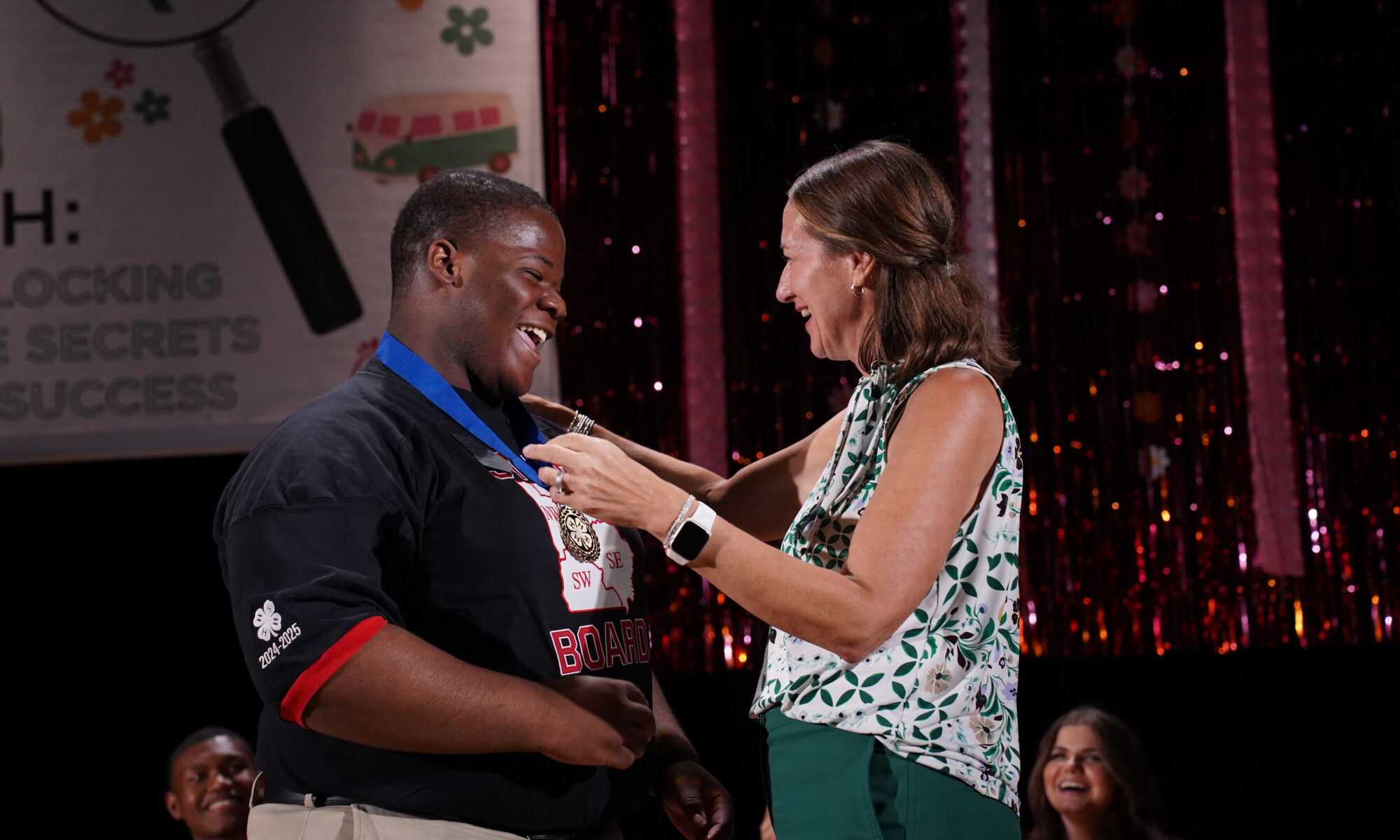
County Extension offices have access to certificate templates for all youth. All participants receive an award lapel pin at the area and state competition. Ribbons are given to the top three winning Senior and Junior teams (up to four members per team placing) and the top three Senior and Junior Overall High Individuals at each area contest. Medallions are given to the top three winning Senior teams (up to four members per team placing) and the top three Senior Overall High Individuals at the state contest. The Senior Overall High Individual is named a Master 4-H’er.
– The State Winning Senior High Individual is permitted to compete in future years as a Senior individual, if they are age-eligible to participate in 4-H programs in future years.
– If the State Winning Senior High Individual is a member of the State Winning (First Place) Senior Team, they are permitted to compete in future years as a Senior individual only, if they are age-eligible to participate in 4-H program in future years.
– If the State Winning Senior High Individual is a not member of the State Winning (First Place) Senior Team, they are permitted to compete in future years as a Senior individual and as a Senior team member, if they are age-eligible to participate in 4-H programs in future years. The (up to four) members of the first-place Senior team members are named Master 4-H’ers. The first-place Senior team members are eligible to compete in the National 4-H Wildlife Habitat Education Program (WHEP).
– Members of the State-Winning (First-Place) Senior Team are ineligible to compete as Senior team members in future years, regardless of whether they compete in the National 4-H Wildlife Habitat Education Program.
– State Winning Senior Team members may compete as individuals in subsequent State 4-H Wildlife Judging Contests and may be recognized as a State Winner as a Senior High Individual, if they are age-eligible to participate in 4-H programs in future years.
– Should an alternate team member be approved to compete in the National 4-H WHEP program as a member of a team, that member is no longer eligible to compete in future Georgia 4-H Wildlife Judging contests as a team member, just as if the member had been on the state winning team. However, the competitor can compete as an individual as long as the competitor is age-eligible to participate in 4-H programs.