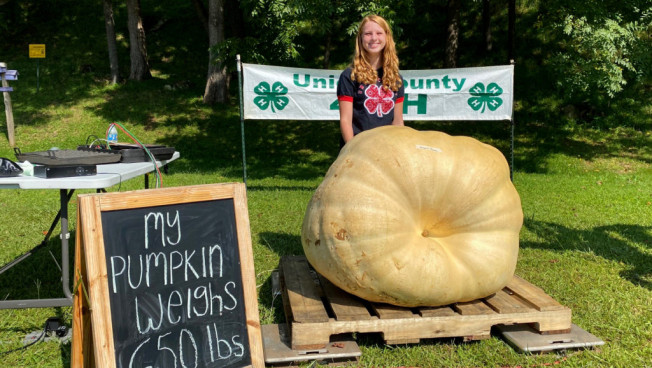
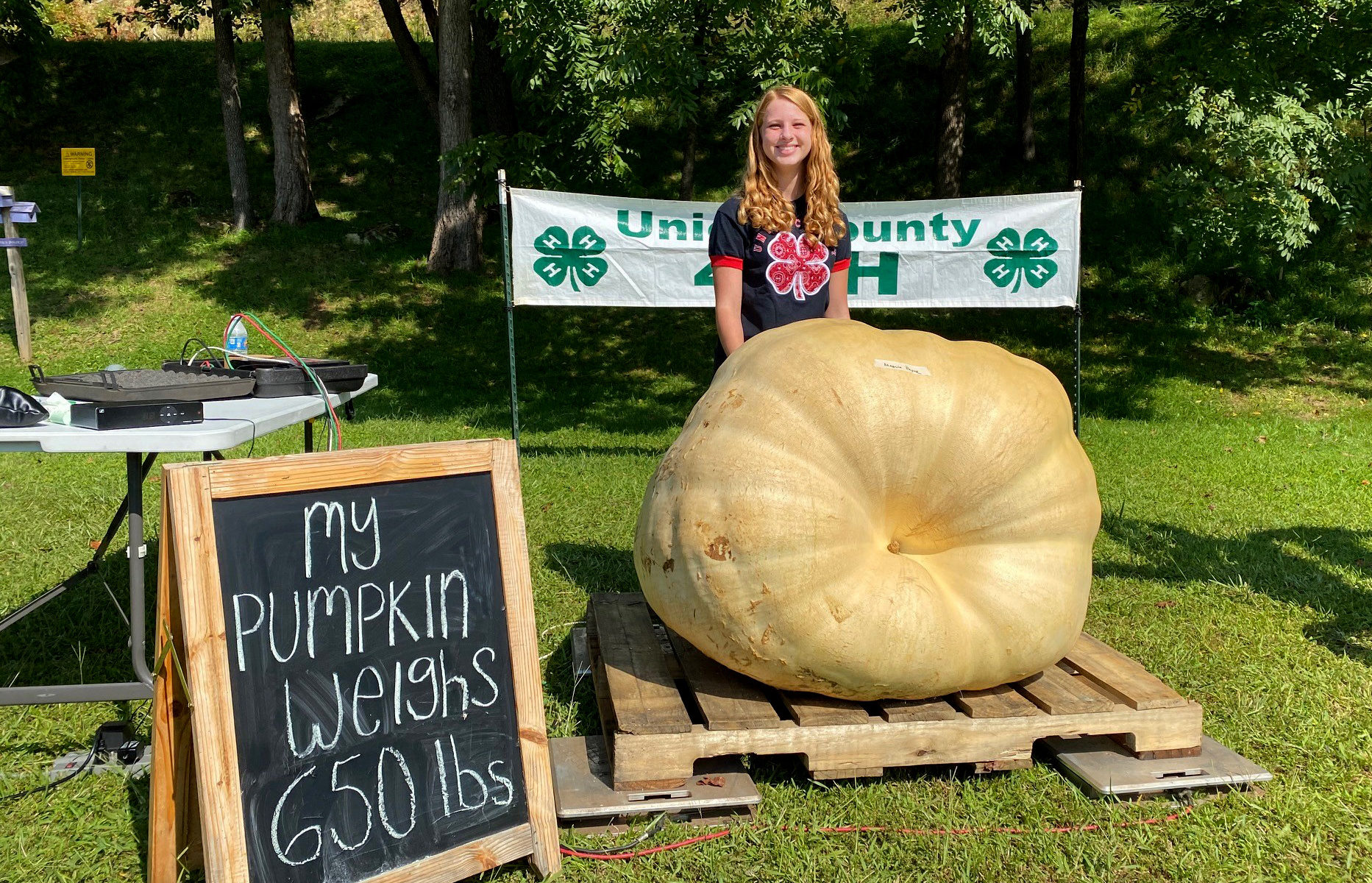
Senior 4-H’er Maggie Payne poses with her first-place winning 650-pound pumpkin at the Union County Extension Office.
More than 30 4-H’ers from across Georgia competed in the 2021 Georgia 4-H Pumpkin Growing Contest, with the winning pumpkin weighing in at 650 pounds. The Pumpkin Growing Contest offers students the opportunity to learn and utilize knowledge of agricultural and environmental sciences to produce prize-winning fruit.
The Georgia Fruit and Vegetable Growers Association generously sponsors this important contest that cultivates in young people an appreciation for proper fruit and vegetable growing techniques. In addition to the basics of caring for pumpkins, contestants incorporate mathematical knowledge of space, depth, and irrigation needs for their plants. They also develop problem-solving skills for common agricultural challenges such as insect control.
Magdalena “Maggie” Payne, an 11th grade 4-H’er from Union County, earned the top honor in the 2021 contest with a 650-pound pumpkin. Second place went to Angelo King-Rallo with a 598-pound pumpkin. King-Rallo is a 9th grade 4-H’er from Union County. Ava Sharp, a Union County 10th grade 4-H’er, earned third place with her 529-pound pumpkin. These students received cash prizes and ribbons to recognize their impressive entries.
Union County enjoyed great success in the contest this year. “We are incredibly proud of our 4-H’ers and the way that they have represented Union County,” said Jacob Williams, Agriculture and Natural Resources Agent in Union County. “This season presented unique challenges, as every season does, but they persevered. We hope that next year we will be able to keep building on the success that we have had.” Williams serves as the leader of the Union County Pumpkin Club.
All Georgia 4-H’ers are invited to participate in the Pumpkin Growing Contest and pumpkin weights are verified by local County Extension offices. State winners were celebrated in conjunction with National Pumpkin Day on October 26, 2021.
Georgia 4-H empowers youth to become true leaders by developing necessary life skills, positive relationships and community awareness. As the largest youth leadership organization in the state, 4-H reaches more than 175,000 people annually through UGA Extension offices and 4-H facilities.
For more information about the Georgia 4-H Pumpkin Growing Contest, visit www.georgia4h.org/pumpkin or contact your local Extension office.
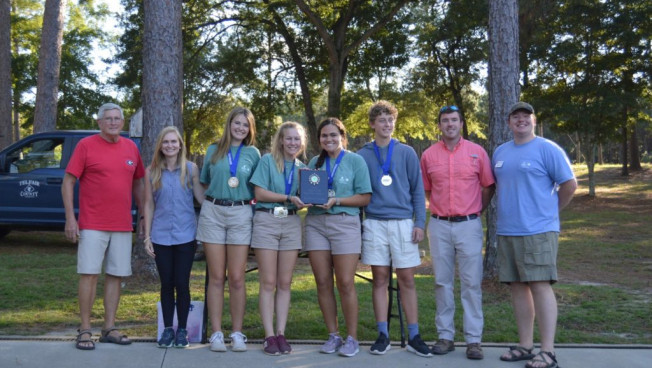
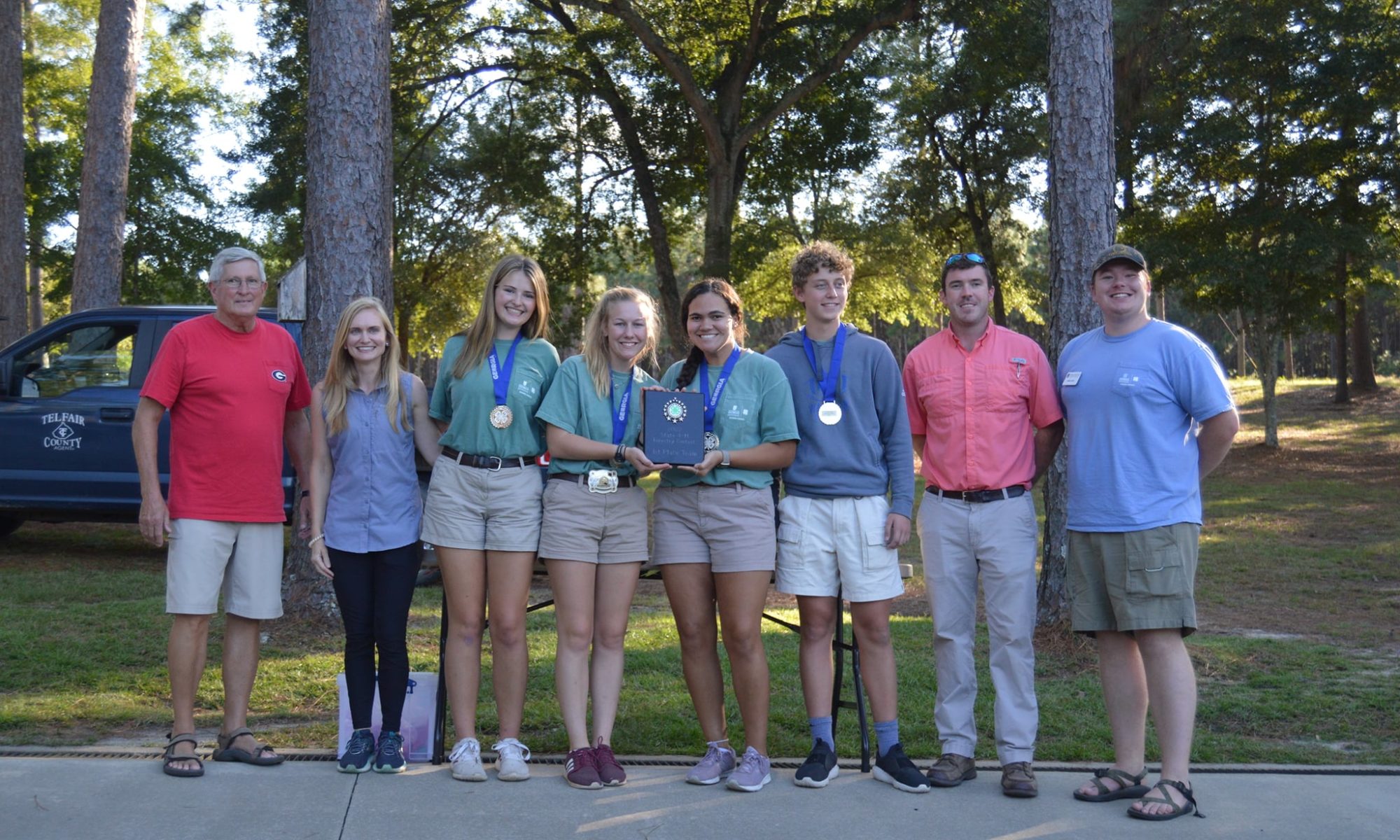
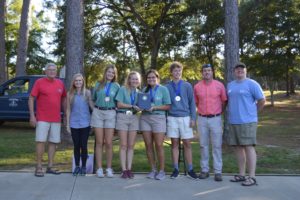
Oconee County is 1st Place Team- (L tob R) Henry Walker, Tree Farm Owner, Coach April McDaniel, Robie Lucas, Lexi Pritchard, Alyssa Haag, Thomas Stewart, Telfair Agricultural Agent Colby Royal, Oconee 4-H Educator Daniel Queen
Jacksonville, Ga. (Sept. 25, 2021) – Thirty-four Georgia 4-H’ers participated in the program year 2022 State Forestry Field Day on Sept. 25 at the Henry Walker Tree Farm in Jacksonville, Georgia.
The Georgia 4-H Forestry program teaches youth to identify up to 70 Georgia tree species, as well as common pests and diseases that impact those trees. The forest field day competition allows youth to test their science-based knowledge, critical thinking skills and skills with specialized forestry tools. Participants can be a part of a county team or compete individually in the state forestry judging contest.
“The Walker Tree Farm was the ideal setting for our state contest. The Walkers led our youth and coaches on a farm tour after the competition concluded. Our 4-H members were able to see real, multiple resource management on a working farm,” said Craven Hudson, University of Georgia Cooperative Extension 4-H specialist. “The setting, the weather and our gracious hosts made for a perfect day.”
The state contest consists of five stations: insect and disease identification, volume estimation, compass and pacing, tree identification and site evaluation. All county teams prepared for the state contest by competing in one of four Area Forestry Field Days held earlier in August and September. Site evaluation is added at the state level and requires youth to consider landowner objectives and make forest management recommendations.
Each county may bring up to 20 senior contestants from ninth through 12th grades. The youth compete individually and as team members. The First Place Senior Team Winners will represent Georgia at the National 4-H Forestry Invitational in August 2022 at the Jackson’s Mill State 4-H Conference Center in Weston, West Virginia.
This year’s winners at the State Forestry Field Day are:
First place team: Oconee County – Alyssa Haag, Robie Lucas, Lexi Pritchard, Thomas Stewart
Second place team: Bulloch County A– Callie Barger, Dorothy Mortimore, Ann Parker, Jackson Thigpen
Third place team: Burke County– Emmaline Cunningham, Tony Gray, Abbie Morgan
Senior High Individual: Alyssa Haag, Oconee County
Georgia 4-H empowers youth to become true leaders by developing necessary life skills, positive relationships and community awareness. As the largest youth leadership organization in the state, 4-H reaches more than 175,000 people annually through UGA Extension offices and 4-H facilities. For more information, visit georgia4h.org or contact your local Extension office.
Mitchell 4-H first youth group named to ‘Clean 13’
By Sue W. Chapman CAES News Updated
CAMILLA — The University of Georgia Cooperative Extension 4-H program in Mitchell County was recognized as a Clean Water Hero in the Georgia Water Coalition’s 2021 Clean 13 Report. The annual Clean 13 Report highlights exceptional efforts to protect Georgia’s water resources.
Mitchell County 4-H is the only youth-serving organization to receive the honor in the five years since the report was established.
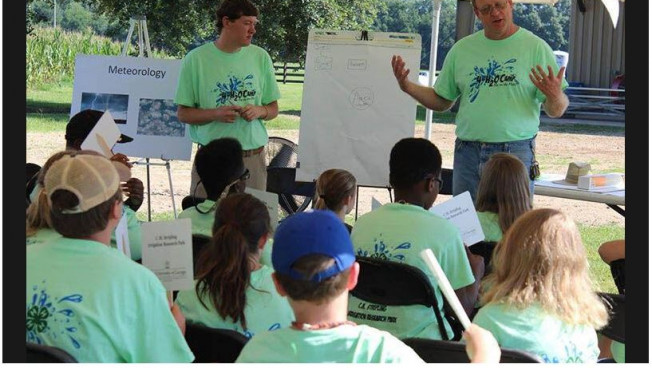
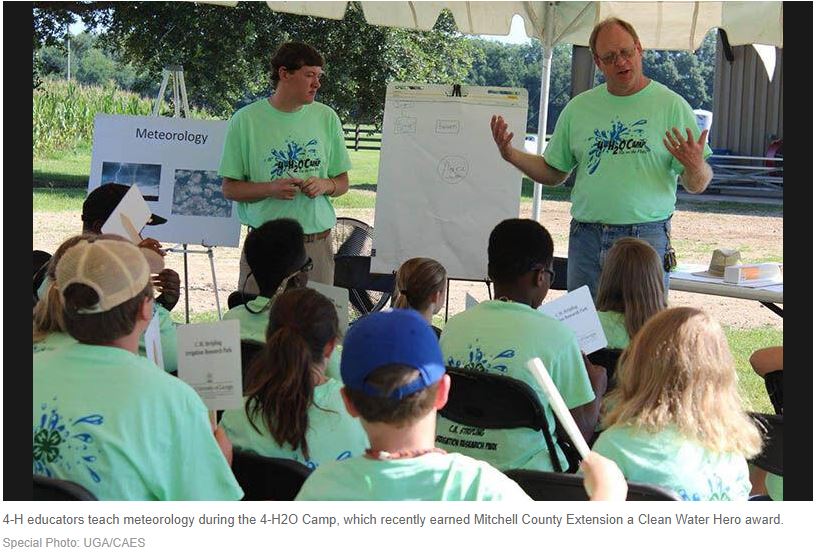
Mitchell County Extension created a 4-H2O Camp in 2008 as a collaboration between UGA’s C.M. Stripling Irrigation Research Park and Mitchell County 4-H. The camp provides an innovative way to educate children and adults about the importance of Georgia’s water resources and water conservation.
Learning about water conservation education is particularly important in southwest Georgia, where the essential resource has a significant impact on the extensive farming community. In recent years, this region has also experienced extended droughts, ongoing political battles with neighboring states over water use, and a devastating hurricane.
Since its founding, hundreds of students from Mitchell County, as well as surrounding counties in south Georgia and Alabama, have attended the annual, three-day 4-H2O Camp, at which students learn from experts including irrigation specialists, solar energy specialists, meteorologists and wildlife biologists. Mitchell County 4-H agent Debra Cox coordinates the camp alongside Agriculture and Natural Resources Agent Brian Hayes.
Cox emphasized that students learn while having fun as they use food, interactive models and other hands-on activities as educational tools, noting that several graduates of the 4-H2O Camp are now working in water conservation and related fields.
“Mitchell County 4-H has hosted the 4-H2O Camp for 14 years, and this is the second award we have received,” Cox said. “In 2019, Mitchell County 4-H and C.M. Stripling Irrigation Research Park received the Georgia Project WET Organization of the Year. 4-H2O Camp is a program that will continue to teach our youth to be good stewards of water in and around southwest Georgia.”
Hayes added, “It is a great honor to be the first youth organization to win the Clean 13 award and to be recognized among some great honorees.”
For more information on 4-H2O Camp, contact Mitchell County Extension.
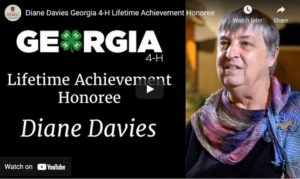
Davies receives Georgia 4-H Lifetime Achievement Award
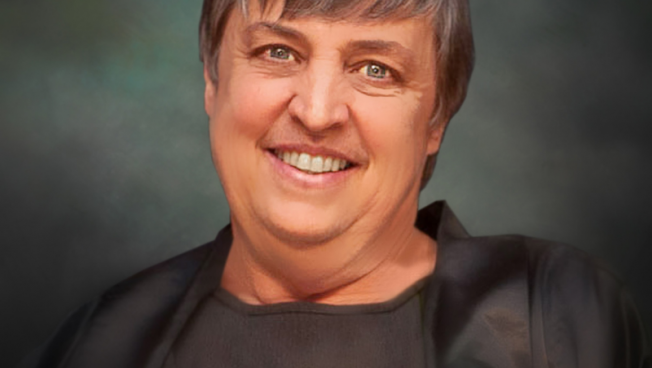
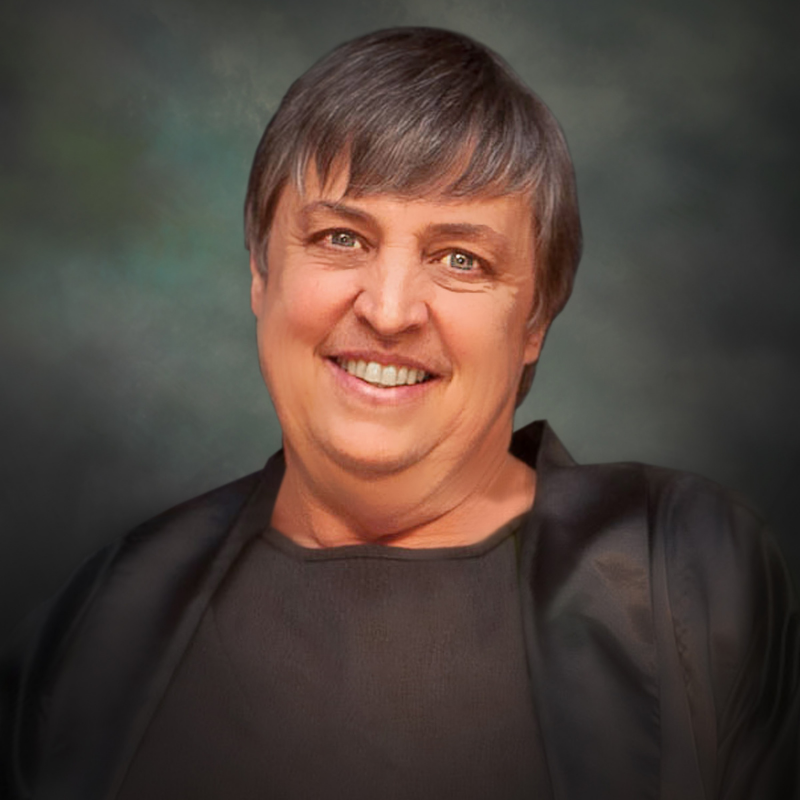
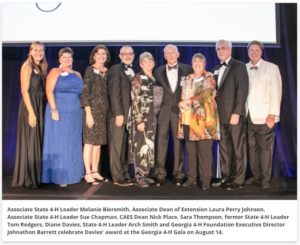
Diane Davies, retired University of Georgia Cooperative Extension 4-H specialist and senior public service associate, received the Georgia 4-H Lifetime Achievement Award at the 2021 Georgia 4-H Gala on August 14.
Davies received the award for her “vision, leadership and sustained support of Georgia 4-H.”
“The award was established to recognize individuals who have dedicated time, energy and resources to Georgia 4-H and is considered the highest honor Georgia 4-H can bestow,” said Melanie Biersmith, associate state 4-H leader. “When one considers the contributions of Diane Davies — her many years of outstanding service, the foundation she created, the legacy she developed and the impact her work has had on Georgia 4-H — it’s easy to understand why she is this year’s recipient. Not only is her work a series of considerable achievements, her work for Georgia 4-H actually represents achievements of a lifetime.”
Davies was hired by UGA Extension in 1979 to launch the Georgia 4-H Environmental Education program to serve youth while increasing revenue at the Rock Eagle 4-H Center in Eatonton, Georgia. Despite limited funds and time, Davies developed relationships with local schools and youth groups to personally deliver curriculum to more than 2,000 participants in the first year.
More than 1.2 million participants have enjoyed the program — using the outdoors as a classroom without walls to engage K-12 students in experiences that highlight the science, natural resources and natural history of local ecosystems — since its inception. This innovative and award-winning program began with a $300 budget, a six-month timeframe and Davies’ determination.
After years of success, Davies was able to hire additional staff and expand the program to the other Georgia 4-H centers: Camp Jekyll (formerly Jekyll Island 4-H Center) and 4-H Tidelands Center on Jekyll Island, Burton 4-H Center (formerly Tybee Island 4-H Center) on Tybee Island, Wahsega 4-H Center in Dahlonega and Fortson 4-H Center in Hampton. By the mid-1990s, more than 40,000 youth from all over the state were participating in the program each year.
“The importance of having children connect to the natural environment and learn from it all that it has to teach them is so vitally important today in their education,” Davies said. “To be given the chance to start the Georgia 4-H Environmental Education program has been the mission of my life’s work and I am truly honored to be the recipient of the 2021 Georgia 4-H Lifetime Achievement Award. It is certainly the capstone of my professional career.”
After the program was well established, Davies focused on soliciting donations and resources to develop additional educational spaces, including the Rock Eagle 4-H Center Museum of Natural History, Wildlife Ecology Building and Woodruff Aquatic buildings.
Davies remained directly involved in programming until her retirement in 2002, continuing to support the program through philanthropic contributions and service in advisory groups and committees.
“Diane Davies continues to be an advocate for the program she founded and tout its impact to all those with whom she comes in contact. Her work was a strong foundation on which we continue to grow today,” Biersmith added.
In 2013, the Georgia 4-H Environmental Education program celebrated its 1 millionth participant.
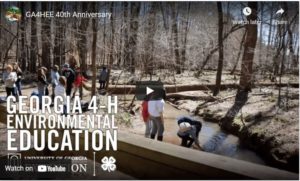
In 2019, Georgia 4-H celebrated the program’s 40th anniversary. During that time, the program has served more than a million participants and generated more than $77 million in revenue to support the overall operation of the state’s 4-H centers.
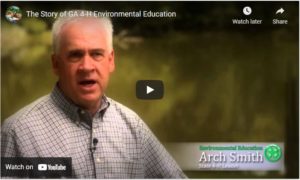
State 4-H Leader Arch Smith states, “Diane Davies’ contributions to 4-H inspired others across America to enhance outdoor learning opportunities. Much of the continued success of the Georgia 4-H facilities is a result of Diane’s efforts to develop the Georgia 4-H Environmental Education program.”
For more information about the Georgia 4-H program, visit Georgia4H.org.
Georgia 4-H announced the 2021-22 State Board of Directors
PUBLISHED ON
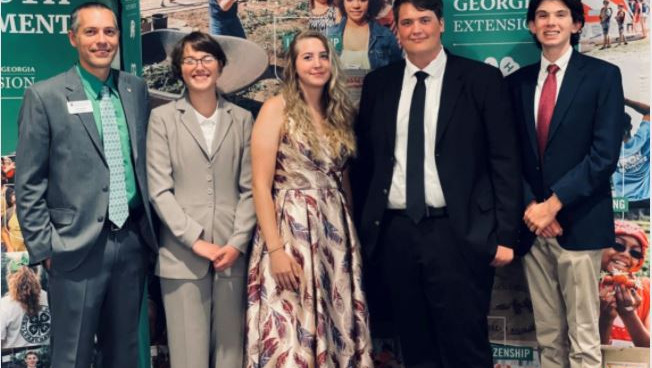
ATHENS, Ga. — Georgia 4-H announced the 2021-22 State Board of Directors as part of an in-person statewide event for high school 4-H’ers called “THE Senior Event.”
Nearly 350 eighth- through 12th-grade youth gathered at Rock Eagle 4-H Center in late June to compete in a series of fun and friendly physical and mental challenges, part of the annual Iron Clover Contest, to enjoy some much-needed fellowship with peers and to learn the results of the 4-H State Board of Directors elections.
In the week leading up to THE Senior Event, virtual campaigning — including candidate speeches, candidate question forums, and electronic campaign posters — was used to introduce this year’s slate of 4-H State Board candidates to voting delegates from around the state.
Because capacity at THE Senior Event was limited due to health and safety protocols, campaigning and voting was conducted virtually to engage more youth in the election process. High school 4-H’ers who qualified as state officer candidates were required to present a campaign speech, extemporaneously respond to randomly selected questions, and answer questions submitted online by fellow 4-H’ers as part of a Virtual Candidate Forum.
Hundreds of youth voting delegates from around the state were able to vote virtually over two rounds. Candidates earning the five highest counts in the first round of voting are elected to the at-large positions on the State Board of Directors — president, vice president and three state representative positions. The second round of voting is a district-level ballot to select four district representatives to complete the Georgia 4-H State Board of Directors. Being elected to serve as a state officer is one of the top leadership positions a 4-H’er can hold.
The 2021-22 Georgia 4-H State Board of Directors are:
President: Katie Beth Brewer, Dodge County
Vice President: Georgia Simmons, Banks County
State Representative: Aniyah Hall, Ben Hill County
State Representative: Jay Lovett, Treutlen County
State Representative: Willie White, Pierce County
Northeast District Representative: Davis Slate, Clarke County
Northwest District Representative: Kaylee Collins, Spalding County
Southeast District Representative: Ashton Ates, Coffee County
Southwest District Representative: Hinano Tomlinson, Sumter County
To learn more about Georgia 4-H, go to georgia4h.org.
Georgia 4-H alums compete in shooting sports at the Tokyo Olympics
By Courtney Cameron for CAES News
After being postponed last year due to the COVID- 19 pandemic, the 2020 Tokyo Olympics are set to move forward at full speed starting Friday, July 23, when people from all over the world will tune in to watch the best of the best compete for gold in Japan.
Among the high-profile athletes competing in popular sports such as swimming and gymnastics, three former Georgia 4-H’ers will make the flight across the Pacific to represent the U.S. in shooting sports.
James Hall of Carroll County, Vincent Hancock of Putnam County, and Katelyn Abeln of Douglas County all got their start in the Georgia 4-H Project SAFE shooting sports program. This program, which uses shooting sports to teach life skills and firearm safety to students, helps 4-H’ers find community, learn about teamwork and fine-tune their concentration.
“The skills these students acquire are irreplaceable. Of course they learn about safety, but they develop soft skills such as communication and goal setting. Having this development at a young age lays a foundation for future success for Project SAFE participants,” explained Faye Belflower, the volunteer air-pistol coach for Georgia 4-H.
James Hall is set to compete on the U.S. National Team in air pistol. While Hall’s mother was anti-gun growing up, she wanted her children to learn about firearm safety, so she signed them up for the Georgia 4-H Project SAFE.
“She ended up being a 4-H coach and sent three of her four boys off to college on athletic/academic scholarships for shooting,” said James Hall, now the director of development for the Scholastic Shooting Sports Foundation (SSSF).
Vincent Hancock will return to the range for the men’s skeet shotgun competition. Hancock, now a resident of Fort Worth, Texas, has previously won two Olympic gold medals, as well as a silver medal in men’s skeet and a gold in the skeet mixed team last month at the International Shooting Sport Federation (ISSF) World Cup in Italy.
“And as a small-town Georgia boy, who never thought he would ever really leave the Southeast, traveling all over and talking to different people and experiencing different cultures, I am very thankful that I had what I had to be able to do what I am doing now,” Hancock said.
Katelyn Abeln, a second-year student at The Ohio State University, is an alternate for the UGA women’s sport and air pistol team on the National Junior Team. She won the women’s division of the National Junior Olympic Air Pistol Championship (NJOSC) last month.
Georgia 4-H Project SAFE gave these Olympic competitors a start in a sport that has changed their lives. It provided opportunities to travel, find community and pursue higher education, and while they will be representing the red, white and blue during the 2020 Games, it’s safe to say there is a little green and white in their hearts.
Georgia 4-H empowers youth to become true leaders by developing necessary life skills, positive relationships and community awareness. As the largest youth leadership organization in the state, 4-H reaches more than 190,000 people annually through University of Georgia Cooperative Extension offices and 4-H facilities. For more information, visit georgia4h.org.
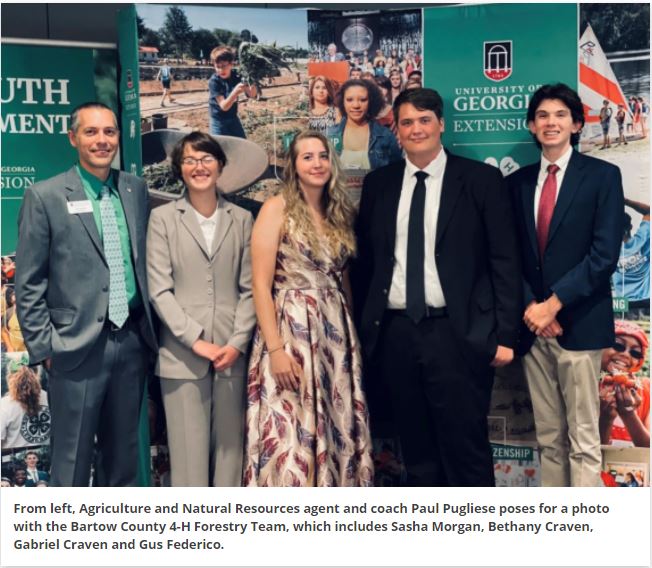
Bartow County 4-H Forestry Team earns top honors in National 4-H Forestry Invitational
By William C. Worrell for CAES News
Georgia placed first among nine states that competed in the National 4-H Forestry Invitational from July 26 through July 28. Teams from Tennessee and Louisiana placed second and third, respectively. Florida, Indiana, Maryland, North Carolina, Virginia and West Virginia also competed in this year’s Invitational.
4-H members competed for overall team and individual awards in several categories. Events included tree identification, tree measurement, insect and disease identification, topographic map use, and a forestry knowledge exam.
The Bartow County 4-H Forestry Team, coached by University of Georgia Cooperative Extension agent and county coordinator Paul Pugliese, included members Sasha Morgan, Bethany Craven, Gabriel Craven, and Gus Federico.
Gabriel Craven from Georgia and Luke Arrowood from North Carolina tied for the highest individual score award. The second-place individual was Bethany Craven from Georgia and the third-place high individual was Josh Griffith from Tennessee.
“This was an incredible honor for our Bartow Country 4-H’ers to represent Georgia at the national contest. I’m proud to have coached these young people over the last several years and to have seen them mature in their forestry knowledge and skills,” said Pugliese. “Two of our team members are high school graduates this year, which makes this a capstone achievement for their 4-H careers.”
The Georgia 4-H forestry program teaches youth to identify 80 tree species and the common pests and diseases that impact those trees. 4-H’ers also develop valuable forestry sciences skills that are foundational for many STEM career pathways. Pugliese added that in light of recent wildfires in the Western U.S., forestry knowledge and skills are invaluable for future generations.
To learn more about Georgia 4-H’s environmental education in natural resources, visit georgia4h.org.
The 2021 National 4-H Forestry Invitational was sponsored by Farm Credit. Farm Credit supports rural communities and agriculture with reliable, consistent credit and financial services. Farm Credit has been helping areas grow and thrive for a century by providing farmers with capital and by financing infrastructure and communication services.
Georgia’s First Flock gets new home designed by 4-H, FFA students
Six teams of Georgia 4-H and FFA members from around the state submitted plans
PUBLISHED ON
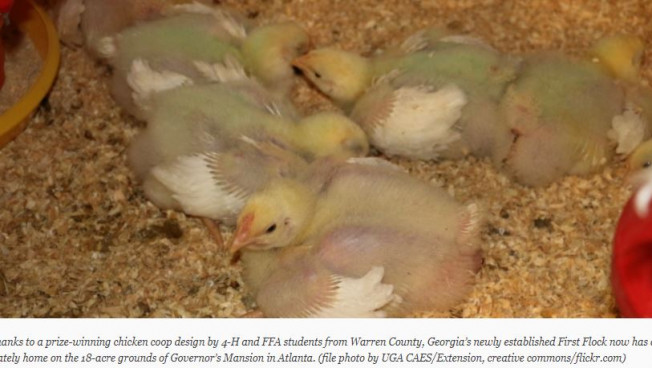
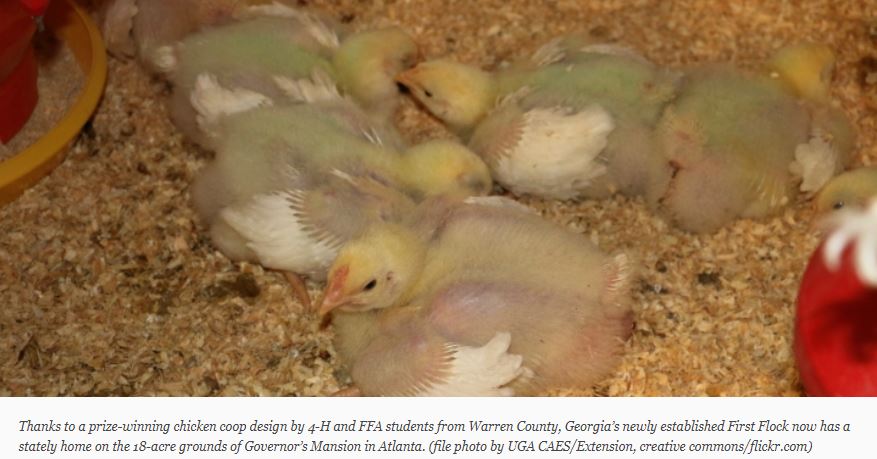
ATHENS, Ga. — Thanks to a prize-winning chicken coop design by 4-H and FFA students from Warren County, Georgia’s newly established First Flock now has a stately home on the 18-acre grounds of Governor’s Mansion in Atlanta.
Born of a conversation between Georgia First Lady Marty Kemp and Bo Ryles, senior director at National 4-H, the Georgia FFA and 4-H Ag Awareness Poultry Project challenged teams of Georgia 4-H and FFA members to submit plans that would help Kemp’s dream of a First Flock become a reality.
Working under a set of guidelines provided to teams by the project partners — including Georgia 4-H, FFA, the Georgia Poultry Federation and the University of Georgia Department of Poultry Science — student teams submitted proposals that included a site plan, concept and, in the case of the winning team, landscaping for the project.
Six teams of Georgia 4-H and FFA members from around the state submitted plans, and all of the teams were invited to visit the Governor’s Mansion on July 9 for the dedication of the project.
“We’ve gotten more than 15 dozen eggs and they’ve only been here for about a month, so they’re very happy,” said Kemp at a ceremony honoring the top teams. “Every night that I’m here, I’ll go out and collect eggs. We all enjoy taking care of the First Flock. They have a special place here and 4-H and FFA are such special organizations. We will continue to support agriculture, 4-H and FFA as long as we are here and beyond.”
Warren County was announced as the winning team before the beginning of COVID-19 pandemic restrictions, but shutdowns delayed the completion of the project until this spring.
Thomas Wilkerson, a 4-H’er and member of the Warren County team, said the team of seven studied the site for the coop and came up with a plan that included the hen house, coop and landscaping for the project that incorporated seating for visitors.
“We wanted to create a coop that would fit the needs of the project and raise awareness of agriculture since poultry is such a large part of the agriculture industry in the state,” Wilkerson said.
Other team members included Randy Olive, Faith McNair, Caleb Griffith, Ayden Hill, Nathan Coffman and Tayvion Robertson, guided by UGA Cooperative Extension 4-H Program Assistant Amanda Wilkerson and FFA Advisor Peggy Armstrong.
“We studied the site where the coop would be placed and came up with all the measurements,” said Olive of the coop, which includes nesting boxes and roosting spaces, as well as a fenced enclosure with plenty of space for the chickens to scratch, watering and feeding stations and a dust bath area. Robertson, an artist, designed and painted a stained-glass window salvaged from an old church that will be installed on the site.
The top four teams each received a cash award from the Georgia Poultry Federation, including the second-place team from Lowndes County, the third-place team from Bulloch County and a team from Toombs County, which received honorable mention.
The Georgia Building Authority worked with 4-H and FFA to develop the site for the coop, while Carroll Daniel Construction of Gainesville took the winning design and created working construction plans to meet all building code requirements. Morton Vardeman and Carlson designed the First Flock logo and Signs by Tomorrow of Gainesville created the First Flock sign that will be installed at the coop.
Once plans were complete, preconstruction work on the coop was done by staff at the Rock Eagle 4-H Center before the coop was delivered to the Governor’s Mansion for installation, said State 4-H Leader Arch Smith.
“We are grateful that Georgia First Lady Marty Kemp was willing to involve youth interested in agriculture in the development of the First Flock,” Smith said. “This experience provided an opportunity of 4-H and FFA members to work together on a project that would showcase the knowledge they have gained by participating in their local programs.”
The First Flock includes breeds chosen for hardiness and egg color and includes a total of 12 laying hens including two Black Australorps, two Buff Orpingtons, two Barred Plymouth Rocks, two Rhode Island Reds — all of which lay brown eggs — and four Easter Eggers, which lay blue-green eggs, said Professor and UGA Cooperative Extension poultry specialist Casey Ritz, who consulted on the project along with Todd Applegate, head of the Department of Poultry Science at UGA’s College of Agricultural and Environmental Sciences.
“We have prepared a set of placard cards that describe the breeds and that will be added to the coop. We tried to purchase a flock of hens that produce a variety of egg colors at the First Lady’s request and breeds that were also recommended from the 4-H/FFA project proposals,” Ritz said.
Applegate encouraged the students to consider the breadth of careers available in poultry science when planning for their futures.
“I challenge the young folks here — and I know it is really difficult to think about why you want to go into a particular career path — to think about how we grow our food and how you can have an impact on that. Think about what you’ve done already through these wonderful organizations and the programs you have been a part of and realize that you are blessed with being in the state of Georgia,” Applegate said.
“There is a wealth of opportunities to make an impact and to choose a career path in poultry, from accounting, sales and marketing to food safety to quality control. The leadership and team-building skills that you are developing right now are certainly skills we need in this industry.”
Ryles said the students involved have become a part of Georgia agricultural history through their work on the project and their involvement in 4-H.
“Through the years, generations of students will come here and see what you have established here, and they will learn a little bit about the history of the First Flock and they will understand the role you played in making that happen,” Ryles said. “I have said this before, and I can’t take credit for it, but it is said that if you want to touch the past, touch a rock. If you want to touch the present, touch a flower. But if you want to touch the future, touch the life of a child and that is what 4-H and FFA and all of our leaders and volunteers do through projects like this.”
For more information on youth agricultural and environmental programming visit Georgia FFA at georgiaffa.org and Georgia 4-H at georgia4h.org.
The Georgia 4-H Dean’s Awards competition provided 26 Georgia 4-H youth the opportunity to showcase their talent, hard work and commitment to their communities. The Dean’s Award is one of the highest honors Georgia 4-H members can earn. Competitors submit a cumulative portfolio that reflects their entire 4-H career, and high-scoring submissions are invited to participate in a separately judged interview session.
A Dean’s Award is presented each year in the following six project areas:
–Agricultural and Environmental Sciences
–Civic Engagement
–Family and Consumer Sciences
–The William “Bill” Edwards 4-H Dean’s Award for Communications and the Arts
–STEM
–The James Harris 4-H Dean’s Award for Leadership
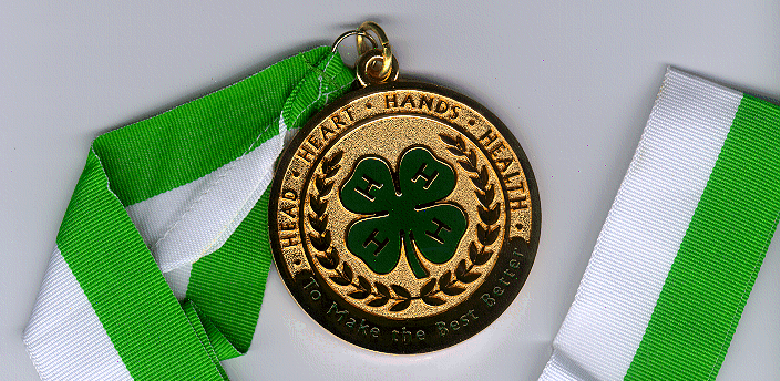
The top three finishers in each area receive a medal for their achievement. First-place winners receive Master 4-H’er status, a $500 scholarship and recognition at 4-H Day at the Capitol.
The 2021 Georgia 4-H Dean’s Awards recipients are:
Agricultural and Environmental Sciences: Bryson Smith, Gordon County (first); Sara Pawlik, Forsyth County (second); and Mary Anna Bentley, Chattooga County (third)
Civic Engagement: Ben Tellano, Hart County (first); Grace McBride, Emanuel County (second); and Evelyn Day, Houston County (third)
Family and Consumer Sciences: Malachi Young, Gwinnett County (first); Tianna Ramey, Habersham County (second); and Angel Jarvis, Candler County (third)
Communication and the Arts: Corbin Austin, Decatur County (first); Kalani Washington, Oconee County (second); and Parker Varnadoe, Madison County (third)
STEM: Nicholas McKinley, Paulding County (first); Salih El-Gayyar, Fayette County (second); and CJ Harris, Newton County (third)
Leadership: Gracie Grimes, Candler County (first); Adam Walters, Hart County (second); and Jhaycee Barnes, Spalding County (third)
Georgia 4-H empowers youth to become true leaders by developing necessary life skills, positive relationships and community awareness. As the largest youth leadership organization in the state, 4-H reaches more than 190,000 people annually through University of Georgia Cooperative Extension offices and 4-H facilities. For more information, visit georgia4h.org or contact your local Extension office.
GEORGIA 4-H SENDS FIVE SHOOTING SPORTS TEAMS TO NATIONALS
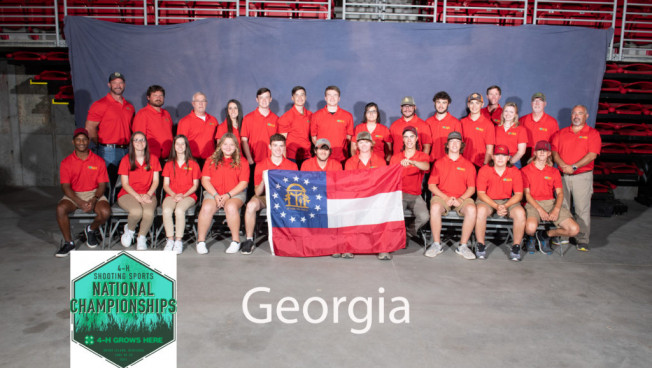
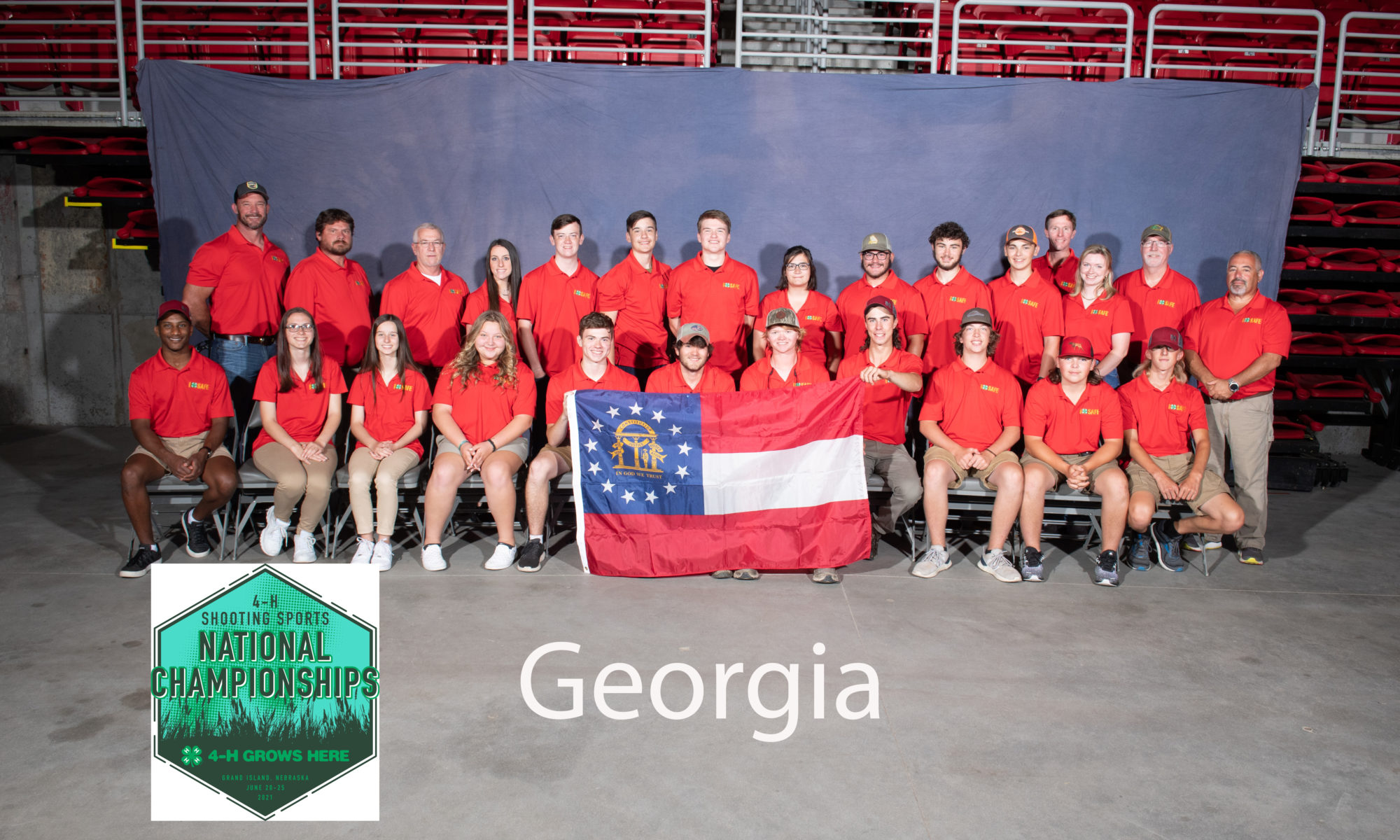
State 4-H champion teams in Sporter Air Rifle, 22 Rifle, Compound Archery, Recurve Archery and Shotgun represented Georgia 4-H at the National 4-H Shooting Sports Championships in Grand Island, NE on June 21-25. Nineteen 4-H’ers and their coaches joined 570 youth competitors from 32 states in the national contest.
The National 4-H Shooting Sports Championships was the first national 4-H event held following closures due to COVID-19. “Everyone was thrilled to gather after missing the opportunity last year due to COVID-19 cancellations. Repeatedly, youth, parents and coaches kept saying what a joy it was to be back together with their peers from across the nation. They expressed deep appreciation to the National 4-H Shooting Sports Committee for making the decision to hold the contest,” commented State 4-H SAFE Coordinator Craven Hudson.
The Morgan County 4-H Recurve Archery Team became national champions by placing first in all three disciplines: FITA, 3-D and Field. Tim Smith was the high individual overall, and his brother, Thomas, placed fifth individually. Complete results for all Georgia 4-H teams and individuals may be found at https://4h.unl.edu/shooting-sports/national-results-images .
Other teams placing in the top ten include Lowndes County Compound Archery (3rd), Pierce County Air Rifle (5th) and Coweta County 22 Rifle (9th).
The Georgia 4-H delegation included the following teams and coaches:
Coweta County 22 Rifle Team with Head Coach Chris Brinton and team members Aaron Boyd, Andrew Boyd, Carson Smith and Jennifer Brinton.
Pierce County Sporter Air Rifle Team with Head Coach David Turner and team members Emily Turner, Gracen Hall, Luke Wester and Skylar Morrison.
Lowndes County Compound Archery Team with Head Coach Jim Barker and team members Joel Ford, Kamron Ford, Camden Humphrey and Irelynn Bono.
Morgan County Recurve Archery Team with Head Coach Danny Pincus and team members Tim Smith, Daniel Lott, Dawson Martin and Thomas Smith.
Columbia County Shotgun Team with Head Coach Tripp Ellis and team members Aidan Caldwell, Joshua Ellis and Nate Williford.
Georgia 4-H empowers youth to become true leaders by developing necessary life skills, positive relationships and community awareness. As the largest youth leadership organization in the state, 4-H reaches more than 190,000 people annually through the University of Georgia Cooperative Extension offices and 4-H facilities. For more information, visit georgia4h.org.