


Wildlife Judging: Creating Site Scenarios
Wildlife Judging: Creating Site Scenarios
Introduction
When completing the Wildlife Management Practices (Activity 2) and Wildlife Management Plan (Activity 3-A), a site scenario (or field conditions) is needed to provide additional context for youth as they observe the site and determine what wildlife management practices are needed.
When organizing practices, Wildlife Judging Coaches will need to examine a site and create a written scenario for youth. Youth must evaluate the site and read the scenario to determine if a practice is needed. While sample scenarios are available, official answers cannot be provided because responses depend on the specific conditions and characteristics of an actual site. Without evaluating a real site, there is no single correct answer to apply to a scenario.
The scenario is typically two pages: one page with written information about the site and one page with an aerial map. For the purposes of the Georgia contest, the contest coordinators try to provide as much information as possible to help youth be successful with these activities.
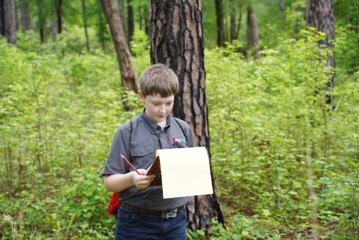
Scenario
The scenario is typically written in paragraph format with the following information about the site:
History of the Site
Knowing the history of the site may be helpful when determining management practices. Past land uses often influence the types of plants and animals present, soil conditions, water quality, and overall habitat structure. This could include information such as:
– previous land uses (cropland, pasture, timber, etc.) and if/when land was converted from one use to another use
– forest management practices that have previously been conducted like prescribed burning, timber harvest, or tree planting
– changes in bodies of water, such as creating or removing ponds, dams, or wetlands or diverting a stream or river
– significant severe weather or natural disasters, such as wildfires, floods, hurricanes, or droughts
– previous wildlife management practices that have occurred on the property
For example, the scenario could say: This site was once a pasture for dairy cows until 1980. At that time, the farmer sold his cows and chose to no longer maintain the pasture. What you see now is the old pasture that is slowly being overtaken with shrubs and small trees.
Landowner Objectives
Knowing the overall management goal and specific objectives the landowner wants to accomplish is perhaps the most important part of the site scenario. This could include information such as:
– increasing the populations of a particular species for observation enjoyment, hunting, trapping, or fishing
– decreasing the populations of a particular species because of overabundance, competition, or human-wildlife conflict
– improving overall wildlife diversity
– restoring native habitat
– creating habitat to specifically attract migratory species
– generating income from timber harvest
– how long the property is going to be managed

For example, the scenario could say: The family has started to notice an abundance of prothonotary warblers in the bottomland hardwoods during the summer seasons. To support this migratory species, the goal is to increase their populations while also restoring the native habitat around the wetland areas for the next three years.
Wildlife management practices should always be selected based on the landowner’s goals. However, there are times when compromises may have to occur and should be noted in the management plan. (Compromises are not considered during the management practices activity because each species should be viewed as the only/focal species.
Property Boundaries and Size of Tract
The size of the property will be shared in acres. The boundaries of the site will be noted on the aerial map. (Conest coordinators will use flagging, cones, etc. to designate areas youth should visit during the activity. Typically, this area is representative of the entire tract.) Any significant components of the site, such as structures, roads, waterways, etc. would also be mentioned.
For example, the scenario could say: This 500-acre property was recently purchased to be used by a large family for a variety of recreational purposes. Four cabins were built to be used at various times throughout the year. Some family members enjoy hunting, especially birds and small game. Others enjoy bird watching alongside the 50-acre lake.
Population Conditions for Some of the Species
Typically, the population conditions for the focal species are going to be shared. This may also be included in the information about the landowner’s objectives. If a wildlife or fish survey has recently been conducted, this will be explicitly stated.
For example, the scenario could say: A recent survey of seining and electro-shocking revealed the fish populations in the lake are relatively low. No largemouth bass were caught, and some newly hatched and intermediate (3-5 inches) bluegill were present.

Special Considerations (if any)
Sometimes, additional special considerations may need to be mentioned. This could include information related to harvesting regulations, cost/budget associated with certain management activities, etc.
For example, the scenario could say: Regulated hunting or trapping is not allowed on the property.
Aerial Map
There are many free and paid versions of software applications that allow users to develop aerial maps. Google Earth is a relatively simple program that has both free and paid versions. Users can search for a specific site and use the satellite type for the base map. You may also want to make the map clean – meaning there are no borders, labels, places, or roads. The add path or polygon feature allows the user to create a shape, and both the area and perimeter can be determined. An example aerial map is below.

Example Scenarios
On the next few pages, you will find sample scenarios. Youth must evaluate the site and read the scenario to determine if a practice is needed. Coaches may be able to use some of these example scenarios for practices, but you cannot rely only on a scenario when practicing. A site is also needed.
For Wildlife Management Practices (Activity 2), Junior youth make recommendations for 4 species, and Senior youth make recommendations for 6 species. Many time, the ending of this scenario will say something like: Given all this information, your goal is to identify management practices to manage habitat for the species listed below. Your task is to choose the wildlife management practices that are appropriate for each species as if it were the only species considered on the site.
Usually, these scenarios (for management practices) are a bit longer because information regarding 4-6 species is being shared.
For Wildlife Management Plan (Activity 3-A), Junior teams write a management plan for one species, and Senior teams write a management plan for two species. Information for at least 1-2 species will be shared, but additional information may also be included. Many times, the ending of this scenario will say something like: Your goal is to write a wildlife management plan for the focal species based on the landowner’s objectives.
In the example scenarios, the ending of the scenario has been intentionally omitted, so that a Coach could alter this for a local site and adjust the wording for either exercise: Wildlife Management Practices (Activity 2) or Wildlife Management Plan (Activity 3-A).
Not all species in the scenarios are applicable to Junior youth. Refer to the latest edition of the Georgia 4-H Wildlife Judging Contest Guidelines for a complete list of Junior and Senior species.
Example #1
Your family recently purchased a 100-acre property that was once a private hunting club. There are 2 large cabins, a 20-acre lake, and numerous trails. The lake is being fed by underwater springs and aquifers as well as rainwater. The buildings haven’t been occupied in over a decade. The property was specifically managed for mourning dove, northern bobwhite, wild turkey, eastern cottontail, raccoon, and white-tailed deer. However, over the years, the fields and forests have been neglected. No recent wildlife surveys have been conducted but your family has already seen numerous raccoons especially around the outdoor trash cans. Additionally, eastern fox squirrels have been found in the attic of one of the cabins. Your main goal is to improve the habitat quality for these species that were hunted here long ago. Besides hunting, your family also wants to establish a healthy bird population for the area, including songbirds, raptors, and waterfowl. No artificial nesting structures are present. Since your family just purchased the property, funds are limited. The goal is for hunting to be the initial, primary use with bird watching being a secondary use in future years. Your family intends to actively manage the property indefinitely, with the goal of being able to sustainably harvest species next hunting season.
Example #2
The field was once a mature pine forest, but the land was recently clearcut for commercial development. However, the developer went bankrupt and now sold the land to a local nonprofit that intends to use the land for wildlife conservation. There are 250 acres, with a stream running through the middle of the property. Only annual forbs and grasses are present. None of the original trees are standing, but there are a few small piles of trees and brush on the site. Substantial erosion has occurred because of the clearcut. Additionally, the water quality of the stream has suffered. The five-year plan is to fully restore native habitat, focusing primarily on insects, birds, and small mammals, with the hopes of increasing the populations of larger mammals and reptiles over time. You did see some eastern cottontails and American bumble bees when observing the site, but no other wildlife species were present.
Example #3
The Clover Wildlife Management Area (WMA) has been operated by the Georgia Department of Natural Resources for the last 50 years. Prior to this, the area was privately owned and consisted of fields, young forests, and mature forests. Today, many of the same elements remain. The various fields are well-known for having quality game for the public to hunt during the various seasons. In particular, northern bobwhite, mourning dove, and white-tailed deer are popular species in the fall and winter, and wild turkey are popular in the spring. Realizing some of these populations need standing water more readily available, a dam was installed on the river running through the WMA, creating a lake. Now that the lake is established, they have decided to allow public fishing and will begin to stock largemouth bass and channel catsifh. Additionally, they plan to install some pavilions and benches near the lake. Managers would like to add some native plants that are good for pollinating insects in that area.
Example #4
The McDonald family grows over 1,000 acres of corn, cotton, soybeans, and peanuts using a crop rotation system in south Georgia. Previously, beef cattle had grazed the property, but no cows remain. There are some young pine stands between the larger fields. Recently, they noticed northern bobwhite and wild turkey moving between the fields and immature forests. Additionally, they think there were some eastern cottontails and easter fox squirrels as well. Realizing that their farm could also be used for wildlife, the family has consulted with you to create a wildlife management plan. There are not any sources of water on the property. They use two wells to operate their irrigation systems. Row crop farming is their first priority, but they do believe there is a way to provide suitable habitat for the species mentioned above.
Example #5
A family friend has some recreational property that includes a large 15-acre lake surrounded by a mature mixed hardwood forest. The lake has not been managed for years, and the spillway needs repairing. Given that they are going to have to spend funds to repair the spillway, they have decided to invest and create suitable wildlife habitat for the fish in the lake and other surrounding wildlife species. After observing the lake, you notice a lot of undesirable aquatic vegetation, including hydrilla and duckweed. On the north side of the lake, you notice the soil is severely eroding into the pond and causing muddy water. Your friends commented that they would like to see more animals around the lake, including American alligators and wood ducks. They also asked if a flower garden might also be a nice feature on the banks.
Example #6
For generations, your family had operated a beef and hog farm in the north Georgia mountains. When checking cows with your father one night, you see wild turkey, white-tailed deer, and eastern cottontail in the pastures with the cows. After a recent 4-H Wildlife judging practice, you learned that there are ways a livestock pasture can be managed in conjunction with different wildlife species. Your dad decides that you will start these new practices in the smaller, 10-acre pasture that includes a small stream some shrubs, and a few trees for shade. Funding is limited, but he is willing to entertain your ideas for the next two years, particularly to see if you may increase the population of some of these game species for family hunting. Although you haven’t seen any coyote, your dad is concerned because he does not want them near the cows and pigs.



The University of Georgia College of Agricultural and Environmental Sciences (working cooperatively with Fort Valley State University, the U.S. Department of Agriculture, and the counties of Georgia) offers its educational programs, assistance, and materials to all people without regard to age, color, disability, genetic information, national origin, race, religion, sex, or veteran status, and is an Equal Opportunity, Veteran, Disability Institution.